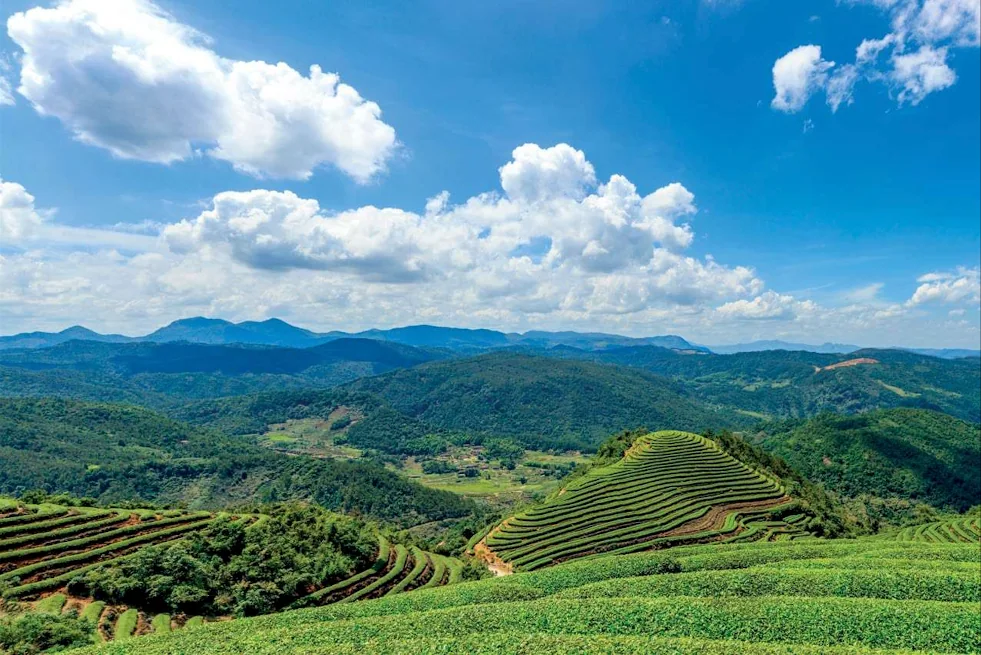
There is a familiar saying in Chinese tea culture:
Good tea comes from high mountains.
There is some truth behind the idea.
Elevation can change temperature, light, cloud cover, humidity, daily temperature range and the speed at which tea shoots grow.
Those changes can influence the chemistry, aroma and texture of tea leaves.
But the slogan becomes misleading when it turns into:
higher mountain = automatically better tea.
Tea is more complicated than that.
What Is High-Mountain Tea?
There is no single worldwide altitude at which ordinary tea suddenly becomes “high-mountain tea.”
The meaning depends on the tea region.
Taiwan provides one of the clearest examples.
Taiwan’s Tea Research and Extension Station describes high-mountain oolong as tea grown at elevations above approximately 1,000 meters. (茶叶品质)
But that does not mean every tea grown at 999 meters elsewhere is lowland tea or that every tea above 1,000 meters belongs to the same category.
Climate changes with:
latitude,
terrain,
slope,
orientation,
local weather,
and surrounding ecology.
So outside defined regional usage, high mountain is often a relative term.
Why Can Elevation Affect Tea?
Imagine climbing a mountain.
As elevation changes, the tea plant may experience different temperatures, cloud patterns and light conditions.
Those changes influence plant growth and metabolism.
Scientific research has found measurable differences in important tea metabolites under different altitude, light and temperature conditions.
One study found that simulated higher-altitude conditions reduced catechin accumulation while increasing free amino acids, including compounds associated with sweetness and umami. (PubMed)
Other research comparing tea cultivars across elevations also found that altitude affected polyphenols, caffeine, catechins and other metabolites—but also found that cultivar itself could be an even stronger factor. (PubMed Central (PMC))
That second point is extremely important.
Altitude matters.
But it is not the whole story.
Cooler Temperatures and Slower Growth
Higher elevations are often cooler.
Cooler temperatures can slow shoot development.
Slower growth can change how compounds accumulate inside the leaf.
This is one reason some high-elevation teas are prized for soft texture, sweetness and aroma.
But “slow growing” is not automatically synonymous with “high quality.”
The final result still depends on cultivar, season and tea-making skill.
What About Mist and Clouds?
Mountain tea gardens often experience mist or cloud cover.
This can reduce direct solar exposure while still providing enough light for photosynthesis.
Changes in light conditions can influence compounds involved in bitterness, sweetness and aroma.
In Taiwanese high-mountain tea, the official Tea Research and Extension Station specifically notes cooler conditions, morning and evening mist, shorter average sunshine duration, lower catechin levels and relatively higher levels of theanine and soluble nitrogen as characteristic factors. (台北市政府)
That helps explain the smooth, sweet style associated with many Taiwanese high-mountain oolongs.
Does Tea Absorb the Smell of the Forest?
This is a romantic idea that appears often in tea descriptions.
A tea grown beside cedar trees may be described as having “cedar mountain fragrance.”
A tea from rocky terrain may be described as having a mineral quality.
But we should be careful.
Tea plants do not simply function like sponges that absorb nearby forest smells and place them directly into the cup.
Environment can influence plant chemistry, and surrounding ecology can affect the growing conditions.
But saying:
“the tea absorbed the aroma of the nearby trees”
is usually too simplistic.
ChinaTea101 prefers to distinguish evocative tasting language from demonstrated plant science.
Does Greater Day-Night Temperature Difference Help Tea?
Mountain areas can experience larger differences between daytime and nighttime temperature.
Temperature is one of many environmental variables that influence plant metabolism and growth.
This may contribute to differences in leaf composition and aroma.
However, elevation should never be considered in isolation.
Two gardens at the same elevation can differ dramatically because of:
soil,
sun exposure,
slope,
rainfall,
wind,
cultivar,
and farming practices.
Is High-Mountain Tea Less Bitter?
Sometimes it can be.
Studies have found associations between higher-altitude conditions and reduced accumulation of certain catechins, which contribute bitterness and astringency, while amino acids may increase under particular conditions. (PubMed)
But this is not a universal tasting rule.
A high-mountain tea can still be bitter.
A lowland tea can be sweet.
Processing and brewing can completely change the experience.
Taiwan High-Mountain Tea
Taiwan is probably the place where the English phrase high-mountain tea has the clearest commercial meaning.
Tea grown above approximately 1,000 meters is commonly described as high-mountain tea, especially lightly oxidized rolled oolong.
Important growing areas include mountain regions in Nantou, Chiayi and central Taiwan. (台北市政府)
These teas often show:
floral aroma,
smooth texture,
freshness,
sweetness,
and good performance over repeated infusions.
But elevation alone cannot guarantee those qualities.
Does Every Chinese Tea Region Use 1,000 Meters?
No.
This is where many tea guides become misleading.
A fixed number such as:
600 meters
or:
1,000 meters
cannot be used as a universal definition for every Chinese tea.
Mountain climates vary greatly.
Tea from Fujian at 700 meters can grow in very different conditions from tea at 700 meters in Yunnan.
Latitude and local geography matter.
So rather than creating one global number, ChinaTea101 recommends asking:
Is this elevation considered high relative to this particular tea region?
High-Mountain Pu-erh
Many famous Yunnan tea areas are mountainous, and elevation is often included in Pu-erh descriptions.
It can be useful information.
But altitude does not prove that a Pu-erh is:
ancient-tree tea,
wild tea,
high grade,
or expensive tea.
A seller giving an impressive elevation number has provided only one piece of information.
You still need to know:
where it came from,
what plant material was used,
how it was processed,
and how it was stored.
High-Mountain Oolong
Oolong is particularly associated with famous mountainous growing regions.
Taiwan high-mountain oolong is one example.
Phoenix Dancong and Wuyi tea also come from mountainous landscapes, although their altitude ranges, cultivars, processing styles and terroirs differ dramatically.
You should therefore avoid using the phrase:
high-mountain oolong
as if all mountain-grown oolongs were one style.
What Is Lowland Tea?
Lowland or flatter-land tea simply refers to tea grown at comparatively lower elevation.
It does not mean bad tea.
Lower-elevation gardens can provide:
warmer conditions,
faster growth,
higher yields,
and different chemical profiles.
Skilled growers and tea makers can produce excellent tea under these conditions.
Is High-Mountain Tea Always Better?
No.
Suppose we have two teas.
Tea A grows at 1,800 meters but is harvested carelessly and badly processed.
Tea B grows at 500 meters from an excellent cultivar and is processed by a highly skilled tea maker.
Altitude alone cannot tell you which cup will taste better.
Recent research examining cultivar and altitude together found significant altitude effects, but also concluded that cultivar was a dominant factor in the material studied. (PubMed Central (PMC))
That is a useful reminder:
terroir is a system, not a number.
What Really Creates Tea Quality?
A useful way to think about tea quality is:
Plant + Place + Season + Farming + Processing + Storage + Brewing
Altitude belongs inside Place.
It matters.
But it is only one component.
How to Evaluate a High-Mountain Tea
When a seller says a tea is high-mountain tea, do not stop at the altitude claim.
Drink it.
Use the ChinaTea101 method.
LOOK
Are the leaves healthy and appropriate for the tea style?
SMELL
Is the aroma clean and expressive?
BREW
Does the tea remain balanced over several infusions?
TASTE
Notice sweetness, bitterness, astringency, body and texture.
READ THE LEAVES
Are the wet leaves healthy, resilient and consistent with the claimed material?
This tells you much more than a number printed on a package.
ChinaTea101 Rule
Higher elevation can influence tea quality. It does not guarantee it.
High-mountain tea can be excellent.
Lowland tea can also be excellent.
Never judge tea using one variable alone.
FAQ
What altitude counts as high-mountain tea?
There is no universal worldwide definition. In Taiwan, high-mountain oolong commonly refers to tea grown above about 1,000 meters. Other tea regions use different local conventions. (台北市政府)
Why is high-mountain tea considered good?
Cooler temperatures, altered light conditions, mist and slower growth can influence tea chemistry, including compounds related to bitterness, sweetness and aroma. (PubMed)
Is high-mountain tea always sweeter?
No. Elevation can influence chemical composition, but cultivar, processing and brewing remain important.
Is high-mountain tea less bitter?
It may contain lower levels of some bitter catechins under certain growing conditions, but this is not universal. (PubMed)
Does higher altitude always mean better tea?
No.
Is all tea above 1,000 meters high-mountain tea?
Not universally. The 1,000-meter convention is particularly established for Taiwanese high-mountain tea. (茶叶品质)
Is lowland tea poor quality?
No. Excellent tea can be produced at relatively low elevations.
Does mountain tea absorb the aroma of surrounding forests?
Environment can affect plant chemistry, but it is too simplistic to say that tea directly absorbs the fragrance of nearby trees.