If you read about Chinese tea for long enough, you will eventually encounter phrases such as small-leaf tea, medium-leaf tea, and large-leaf tea.
Pu-erh is often described as being made from large-leaf tea plants, while many famous Chinese green teas are associated with comparatively small-leaf cultivars.
This can make it sound as if leaf size determines what kind of tea a plant can become.
It does not.
Leaf size is an important characteristic of a tea plant, but it is only one clue among many.
A large leaf does not automatically mean Pu-erh.
A small leaf does not automatically mean green tea.
And you usually cannot identify a tea cultivar simply by measuring one leaf.
Understanding leaf size is useful because it helps you learn how tea plants differ from one another. But it works best when combined with information about cultivar, growing region, processing, aroma, flavor, and the appearance of the brewed leaves.
What Does “Leaf Size” Mean in Chinese Tea?
In Chinese tea discussions, you may see terms such as:
小叶种 — xiǎo yè zhǒng Small-leaf type
中叶种 — zhōng yè zhǒng Medium-leaf type
大叶种 — dà yè zhǒng Large-leaf type
特大叶种 — tè dà yè zhǒng Extra-large-leaf type
These descriptions are generally based on the size of a mature tea leaf while growing on the plant.
That point matters.
The dry tea leaves in your package may have been rolled, twisted, pressed, folded, broken, or compressed.
A tightly rolled oolong leaf can look extremely small when dry and then expand into a surprisingly large leaf after brewing.
So the size of the dry tea in your hand is not necessarily the same thing as the botanical leaf-size category of the tea plant.
Tea Leaf Size Classification
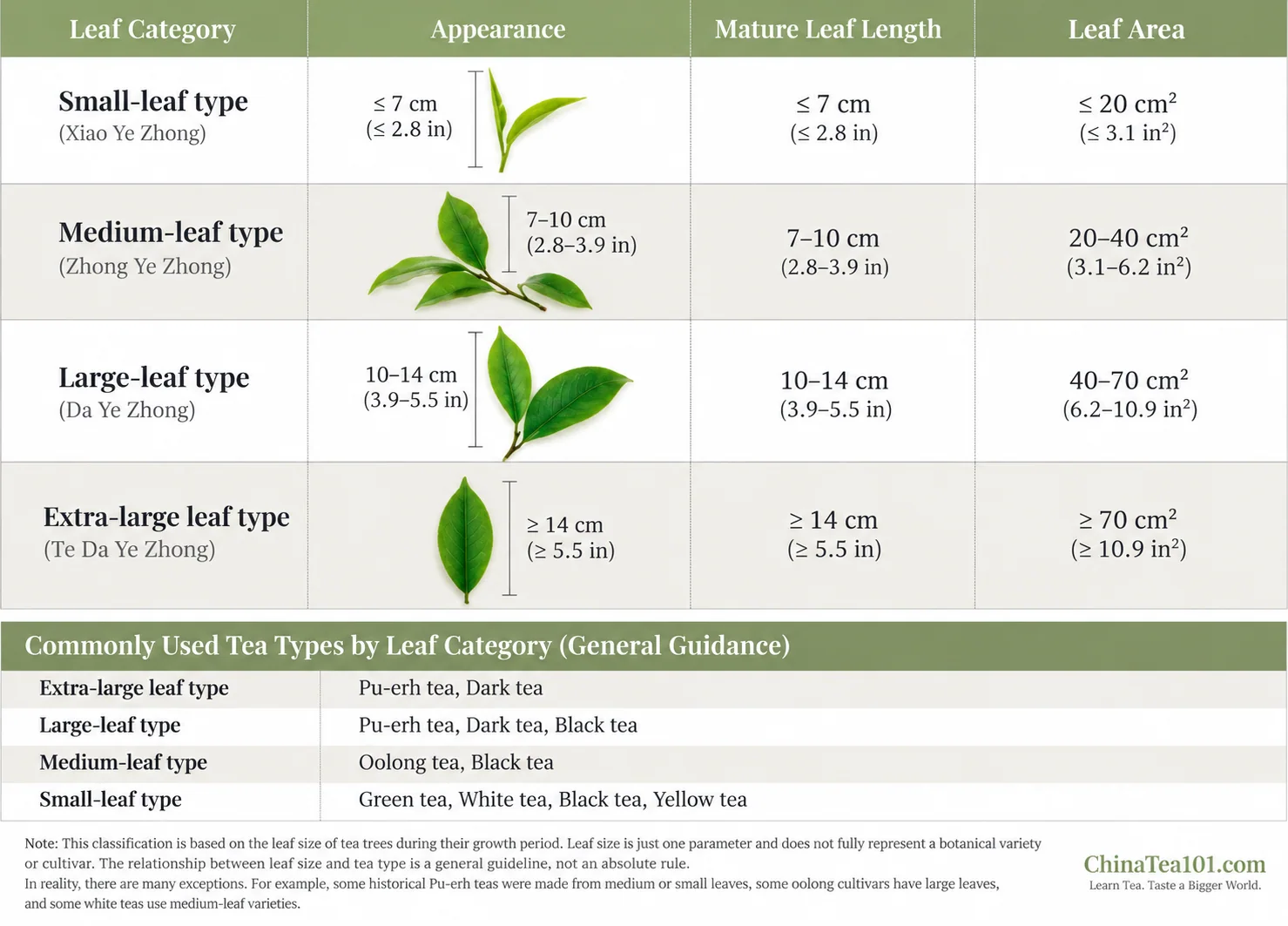
A practical leaf-size guide commonly uses both mature leaf length and approximate leaf area.
| Leaf Type | Mature Leaf Length | Approximate Leaf Area |
|---|---|---|
| Small-leaf type | 7 cm or less | 20 cm² or less |
| Medium-leaf type | 7–10 cm | 20–40 cm² |
| Large-leaf type | 10–14 cm | 40–70 cm² |
| Extra-large-leaf type | More than 14 cm | More than 70 cm² |
These measurements are useful for describing tea plants, but they should not be treated as an absolute identification system.
Natural variation occurs within cultivars, and leaf size can also be influenced by growing conditions, plant age, picking position, and other factors.
Think of the categories as a descriptive framework, not a fingerprint.
Which Teas Are Usually Made From Large-Leaf Tea Plants?
Large-leaf and extra-large-leaf tea plants are especially associated with Yunnan tea material and Pu-erh production.
That is why descriptions of Pu-erh frequently mention Yunnan large-leaf tea varieties.
Large-leaf material is also used for some Chinese black teas and dark teas.
However, this does not mean that every large-leaf tea becomes Pu-erh.
The freshly picked leaves still need to go through a specific production process before the finished tea can be called Pu-erh, black tea, dark tea, or another category.
The plant material provides the starting point.
Processing creates the finished tea.
Why Is Pu-erh So Strongly Associated With Large Leaves?
Yunnan is home to many tea populations with relatively large mature leaves.
Some old tea trees in the region can produce leaves that look dramatically larger than the leaves beginners may associate with ordinary green tea.
This makes large-leaf material one of the recognizable characteristics associated with Pu-erh.
But there is an important distinction:
Leaf size alone does not make a tea Pu-erh.
A tea must also meet requirements related to origin, raw material, and processing.
This is why looking at one large wet leaf and saying, “This must be Pu-erh,” is not a reliable way to identify tea.
What About Small-Leaf Tea Plants?
Small-leaf cultivars are widely used across many Chinese tea-producing regions.
They are commonly associated with teas such as green tea, yellow tea, some white teas, and many black teas.
Some famous green teas use tender buds and young leaves from comparatively small-leaf cultivars.
Because these teas are often picked very young, the harvested material can appear especially delicate.
But again, the relationship is not absolute.
A small-leaf cultivar can be processed into more than one kind of tea.
Tea category depends primarily on what the tea maker does to the leaves after picking.
Medium-Leaf Tea Plants
Medium-leaf tea plants sit between the two extremes and are common in a wide range of Chinese tea traditions.
Many oolong cultivars fall into this general range, although oolong is far too diverse to be defined by leaf size.
Some black teas also use medium-sized leaf cultivars.
This is a good example of why a simple rule such as:
“Oolong = medium leaf”
would be misleading.
Some oolong cultivars have noticeably larger leaves.
Others are smaller.
The processing method is much more important in determining whether the final tea becomes oolong.
Can You Identify Tea Type From Leaf Size?
Not reliably.
Suppose you open a package and find large leaves.
Those leaves could potentially belong to material used for:
Pu-erh, black tea, dark tea, oolong, or another tea depending on cultivar, origin, and processing.
Likewise, finding small leaves does not automatically identify a tea as green tea.
ChinaTea101 recommends treating leaf size as part of a larger investigation.
Instead of asking only:
“How large is this leaf?”
ask:
What shape is it?
How was it processed?
What does it smell like?
What color is the liquor?
How does it taste?
What do the leaves look like after brewing?
Tea identification becomes much more reliable when several clues agree.
Dry Leaf Size Can Be Misleading
One of the most common beginner mistakes is judging tea leaves only before brewing.
This is especially misleading with rolled oolong.
A dry Tieguanyin leaf may look like a compact green pellet.
Add hot water, and that small pellet can unfold into a surprisingly broad leaf.
Pu-erh can create the opposite problem.
Leaves may be compressed tightly into a cake, making it difficult to see their original size until several infusions have loosened the material.
This is why ChinaTea101 places so much emphasis on wet-leaf inspection.
The brewed leaf often tells you more about the original plant material than the dry tea does.
How to Examine Tea Leaf Size at Home
After brewing your tea, take several representative leaves and gently spread them on a flat surface.
Do not choose only the largest or most attractive leaf.
Look at the overall pattern.
Notice the length and width of the leaves, but also pay attention to thickness, veins, edges, stems, buds, and how flexible the leaf feels.
You may discover that leaves that looked tiny while dry were simply tightly rolled.
You may also discover broken pieces that originally belonged to much larger leaves.
This exercise will not automatically identify a cultivar, but it trains your eye to notice plant characteristics rather than only the appearance of the finished dry tea.
Does Larger Leaf Mean Better Tea?
No.
Large leaves are not automatically better than small leaves.
Small leaves are not automatically more delicate or more premium.
Tea quality depends on many factors, including the cultivar, growing conditions, harvest, raw material, tea-making skill, storage, and brewing.
Different tea traditions intentionally use different plant materials.
Trying to rank tea quality by leaf size is a little like judging fruit quality by asking whether apples are better than grapes because apples are larger.
They are different materials suited to different purposes.
Does a Large Leaf Mean an Old Tea Tree?
No.
This is another useful distinction.
Large leaf describes leaf morphology.
Old tree describes the age or growth history of the tea plant.
They are not the same concept.
A relatively young plant belonging to a large-leaf cultivar can produce large leaves.
Likewise, the age of a tea tree cannot be accurately determined simply by examining the finished dry tea.
Be cautious when sellers use large leaves as visual “proof” of ancient-tree tea.
Leaf size alone cannot establish that claim.
Why Leaf Size Still Matters
If leaf size cannot tell us everything, why learn it?
Because it helps you see tea as a plant rather than only as a finished product.
Once you begin examining real tea leaves, you notice that Chinese tea has enormous botanical diversity.
Some leaves are tiny and delicate.
Others are long and narrow.
Some are thick and leathery.
Some are rounder.
Some have strongly serrated edges.
Some have obvious veins.
These differences help shape how tea plants grow and how producers work with them.
Learning to notice leaf size is therefore part of learning to read tea.
Leaf Size and the ChinaTea101 Method
At ChinaTea101, we do not want you to memorize a table and stop there.
Use leaf size as part of our five-step approach:
LOOK → SMELL → BREW → TASTE → READ THE LEAVES
When you reach the final step, spread out the brewed leaves and ask:
How large are they?
Are they thick or thin?
Are they tender or mature?
Do you see buds?
Are there long stems?
Are the leaves complete or broken?
How much did they expand during brewing?
Over time, these observations become much more useful than simply memorizing the names of tea categories.
Large Leaf vs Small Leaf Tea: The Simple Answer
If you remember only one thing from this page, remember this:
Large-leaf and small-leaf describe characteristics of tea plants. They do not, by themselves, determine tea type or tea quality.
Large-leaf material is strongly associated with teas such as Pu-erh and some Yunnan black teas.
Smaller-leaf cultivars are common in many green, yellow, black, and other tea traditions.
But there are many exceptions.
Tea is too diverse for leaf size to work as a single identification rule.
Use it as evidence.
Not as a verdict.
FAQ
What is large-leaf tea?
Large-leaf tea generally refers to tea plants whose mature leaves fall into a comparatively large size range. In Chinese tea, large-leaf material is strongly associated with Yunnan and Pu-erh, although it can also be used for other tea types.
Is Pu-erh always made from large leaves?
Pu-erh is strongly associated with Yunnan large-leaf tea material, but leaf size by itself is not enough to identify or define Pu-erh.
Is small-leaf tea the same as green tea?
No. Small-leaf describes the tea plant’s leaf size. Green tea describes a processing category. Small-leaf cultivars can be used for several kinds of tea.
Are large tea leaves better?
No. Leaf size is not a quality grade. Large-leaf and small-leaf cultivars can both produce excellent tea.
Does leaf size tell you the tea cultivar?
Not reliably. Leaf size can provide clues, but cultivar identification requires more information.
Should I measure dry or wet tea leaves?
Wet leaves are usually much more useful because rolling, twisting, breaking, and compression can make dry leaves appear much smaller than they originally were.
Why do oolong leaves become so large after brewing?
Many oolongs are tightly rolled during processing. Hot water allows the leaves to gradually unfold, revealing their original size.
Can large leaves prove that tea came from an ancient tea tree?
No. Leaf size cannot prove the age of a tea tree.