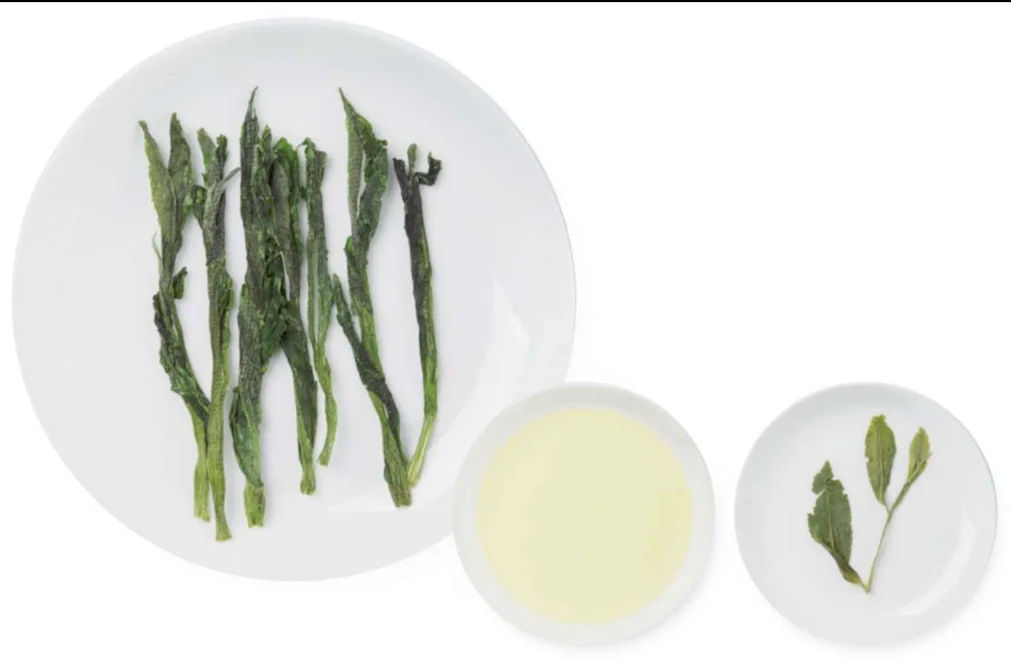
Huangshan Maofeng is defined by its sparrow-tongue shape and protected Anhui origin — not to be confused with its geographic neighbor Taiping Houkui, which has its own distinct shape and standard.
Huangshan Maofeng (黄山毛峰) is a protected green tea from the area around Mt. Huangshan (Yellow Mountain) in Anhui, and — like several other famous Chinese teas — it shares its home region with a very different, equally famous tea: Taiping Houkui. Both come from the same general Anhui mountain area and both carry their own national geographical-indication standard, but they are not variations of the same product. The clearest way to tell them apart on sight is shape: Huangshan Maofeng’s national standard (GB/T 19460-2008) describes its top grade as shaped like a sparrow’s tongue (雀舌) — small, plump, curved buds — while Taiping Houkui’s standard describes a distinctly different “two leaves embracing one bud” (两叶抱一芽) form, larger and flatter.
The name itself is descriptive rather than mysterious: “毛峰” (maofeng) means roughly “fur peak,” referring to the fine down visible on the tender bud tips, and “黄山” places it at Mt. Huangshan specifically. The Source Library flags one genuine nuance worth knowing — “毛峰” as a shape/style term shows up on other teas too, so seeing “maofeng” on a package doesn’t by itself confirm this specific protected tea; the protected name is “黄山毛峰” as a whole, tied to the standard’s defined growing area.
That protected area is specific: seven named districts and counties around Mt. Huangshan (Tunxi, Huangshan, Huizhou, She, Xiuning, Qimen and Yi), using Huangshan-native cultivars and closely related local selections. Harvest for top grade begins in mid-March and favors one bud with a single unfurling leaf; lower grades use progressively larger bud-and-leaf combinations as the season goes on.
Processing follows the general roasted-green-tea (烘青) sequence — spreading, kill-green, shaping, then a two-stage drying process (an initial “hair fire” followed by cooling and a final “foot fire”) — with the shaping step singled out in the standard as the most identifiable part of the process, since that’s where the sparrow-tongue form is created through rolling or hand-shaping.
See the Green Tea guide for where Huangshan Maofeng sits among China’s protected green teas, and Taiping Houkui for the direct shape-and-origin comparison against its better-known mountain neighbor.
Look · Dry leaf
Top-grade dry leaf is described in the national standard as plump, even buds shaped like a sparrow's tongue, with visible down and an ivory-green color flecked with golden tips. This shape is the key visual distinction from its Anhui neighbor Taiping Houkui, whose standard describes a "two leaves embracing one bud" form instead.
Smell & taste
Typical aroma: fresh, persistent, floral. Flavor tendencies: fresh, mellow, sweet aftertaste. Body: light-medium. These vary by batch, storage and brewing.
Brew · A starting point
Try 3 g in 150 ml water at 80–85°C for 60–90 seconds. Fully decant before tasting.
Read the wet leaves
Descriptive tasting notes for top grade in the standard focus on the sparrow-tongue shape and ivory-green color carrying through to the infused leaf. Appearance alone does not confirm the protected origin or grade.
Sources & review status
- ChinaTea101_GI_Tea_Content_Asset_Library.md — Section 5.9 (Huangshan Maofeng dedicated GI profile); Section 16 chart-suggestion note on Huangshan Maofeng vs Taiping Houkui as "two famous teas from the same mountain" — ChinaTea101 owner-supplied Source Library. Used for the full national GI standard profile (GB/T 19460-2008): protected area (seven named districts/counties around Mt. Huangshan), permitted cultivars, harvest timing and bud/leaf composition by grade, the process sequence with shaping (sparrow-tongue) flagged as the most distinctive step, sensory grading by tier, and physicochemical limits (moisture ≤6.5%, powder ≤0.5%, total ash ≤6.5%, water extract ≥35.0%). Also used for the explicit shape contrast against Taiping Houkui (sparrow-tongue vs. two-leaves-embracing-one-bud) documented in the library's comparison notes.
- 中国绿茶标准研究资料库_ChinaTea101_Research_Master_File.md — Section 6.4 (Huangshan Maofeng entry, flagging an earlier NY/T 782-2004 industry-standard abstract as insufficient on its own) — ChinaTea101 owner-supplied Source Library. This file's own entry explicitly notes its knowledge base held only an abstract of NY/T 782-2004, insufficient for a full profile — flagged and not used as the primary source for this page. The GI Asset Library's GB/T 19460-2008 entry (a fuller, current national GI standard) was used instead.
Imported from ChinaTea101_GI_Tea_Content_Asset_Library.md. Updated 2026-09-24. Last reviewed 2026-09-25
How we check claims