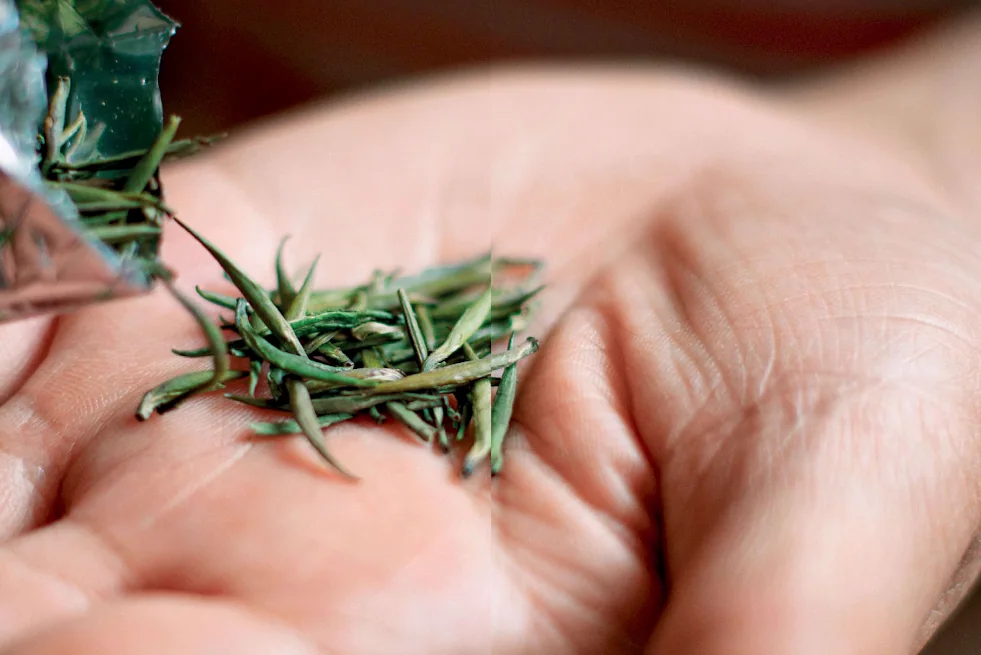
Green tea is one of the oldest and most diverse tea traditions in China.
Longjing.
Biluochun.
Huangshan Maofeng.
Taiping Houkui.
Lu’an Guapian.
Enshi Yulu.
They all belong to the same broad tea category, yet they can look dramatically different.
Some are flat.
Some are curled.
Some resemble needles.
Some are long and blade-like.
Some smell roasted and nutty.
Others are fresh, vegetal or floral.
So what actually makes all of them green tea?
The answer is not simply the color.
It is what the tea maker does to the leaf after it is picked.
What Is Green Tea?
Green tea is made by heating fresh tea leaves relatively early in processing to stop most enzymatic oxidation.
That heating step is known in Chinese as:
杀青 — Shā Qīng
Usually translated as:
kill-green
The name sounds dramatic, but the idea is simple.
Freshly picked tea leaves naturally contain enzymes that begin changing the leaf when its cells are damaged.
If this oxidation is allowed to continue, the leaves gradually change chemically and can eventually be processed into styles such as oolong or black tea.
Green-tea makers intervene early.
They apply heat.
This deactivates the relevant enzymes and helps preserve much of the fresh, green character of the leaf.
A modern scientific review describes steaming and pan-firing as two major heating approaches used to halt oxidation in green-tea manufacture. (PubMed Central (PMC))
Green Tea Is Not “Unprocessed Tea”
This is an important beginner misconception.
Green tea may taste fresh, but it is not simply:
fresh leaves that were dried.
Producing high-quality green tea can involve:
- picking
- resting or withering
- heat fixation
- rolling
- shaping
- drying
- sorting
The exact sequence depends on the tea.
In fact, some of China’s most famous green teas require highly skilled shaping during heating and drying.
Longjing is an obvious example.
Its famous flat shape is created by human processing.
The tea did not grow that way.
Why Is It Called Green Tea?
Chinese calls green tea:
绿茶 — lǜ chá
Literally:
green tea
The name reflects the general goal of preserving green characteristics in:
- the processed leaf
- the brewed liquor
- the wet leaves
But do not expect every green tea to be emerald green.
Real green tea may appear:
- yellow-green
- olive green
- dark green
- gray-green
- silvery green
Some teas may even contain brownish areas.
Color depends on:
cultivar,
harvest,
processing,
storage,
and age.
So:
Brighter green does not automatically mean better tea.
How Chinese Green Tea Is Made
A simplified green-tea process looks like this:
Fresh leaves
↓
Resting / withering where appropriate
↓
Kill-green
↓
Rolling or shaping
↓
Drying
But there are many variations.
One of the easiest ways to understand Chinese green tea is to look at how heat is used.
Chinese green teas can broadly include:
- Pan-fired green tea
- Baked green tea
- Steamed green tea
- Sun-dried green tea
Scientific studies of Chinese green tea commonly distinguish these four manufacturing styles. (PubMed Central (PMC))
1. Pan-Fired Green Tea — 炒青绿茶
Chǎo Qīng
Pan-fired green tea is one of the most important Chinese green-tea traditions.
The leaves are heated and worked in a hot pan or similar heated equipment.
Depending on the tea, heat can help:
- stop oxidation
- remove moisture
- shape the leaves
- create characteristic aromas
What Does Pan-Fired Green Tea Taste Like?
Pan-firing can encourage aromas that tea drinkers describe as:
- chestnut
- roasted bean
- nuts
- warm grain
- fresh greens
Longjing is famous for this kind of character.
Modern chemical studies show that different heating and drying methods produce measurably different volatile aroma profiles in green tea. (PubMed Central (PMC))
That means the familiar chestnut-like character of some Chinese green teas is not simply the natural smell of fresh tea leaves.
Processing helps create it.
What Does Pan-Fired Tea Look Like?
There is no single shape.
Tea makers can shape pan-fired green tea into:
- flat leaves
- curled leaves
- twisted leaves
- needle-like leaves
- small pellets
This is why processing method and leaf shape should not be confused.
Two pan-fired teas may look completely different.
Famous Pan-Fired Green Teas
Examples include:
Longjing — 龙井
Flat, pressed leaves with fresh, nutty and chestnut-like characteristics.
Biluochun — 碧螺春
Small curled leaves, often highly aromatic.
Xinyang Maojian — 信阳毛尖
A needle-shaped pan-fired green tea from Henan, one of China’s best-known “top ten” teas.
Rizhao Green Tea — 日照绿茶
A northern Chinese green tea from Shandong, grown further north than most Chinese tea gardens.
→ Learn about Rizhao Green Tea
Yuhua Tea — 雨花茶
A straight, needle-shaped green tea from Nanjing, Jiangsu.
Gunpowder Tea — 珠茶
Small, round, tightly rolled granules — the shape that gives this tea its Western nickname.
Green Gem Tea — 绿宝石绿茶
A Guizhou green tea with a similar rolled-granule shape to Gunpowder Tea, distinguished by visible down on the leaf.
Xiangxi Huangjin Tea — 湘西黄金茶
A strip-shaped Hunan green tea with an unusually high amino acid content.
→ Learn about Xiangxi Huangjin Tea
Other Chinese green teas may also use pan-heating in different stages of processing.
2. Baked Green Tea — 烘青绿茶
Hōng Qīng
Baked green tea uses hot air or baking as an important drying method.
Instead of continually working the finished leaves against the hot surface of a pan, the tea may be dried through heated air.
This creates a different thermal environment and can produce a different aroma profile.
Research comparing pan-fired, baked and steamed teas confirms that processing method significantly changes both volatile aroma compounds and sensory character. (PubMed)
What Does Baked Green Tea Taste Like?
Depending on the tea, baked green tea may show:
- clean vegetal notes
- flowers
- gentle sweetness
- fresh aroma
- soft baked or warm notes
It would be misleading to say that baked green tea is always less fragrant than pan-fired green tea.
Different teas and different processing intensities produce very different results.
Famous Baked Green Teas
A few important examples are:
Huangshan Maofeng — 黄山毛峰
A famous Anhui green tea with tender leaf material and a gentle, fresh character.
Taiping Houkui — 太平猴魁
Famous for unusually long, flattened leaves.
The shape itself makes it one of China’s most visually distinctive teas.
Lushan Yunwu — 庐山云雾茶
A protected Jiangxi green tea named for the fog-belt mountain it grows on — “Yunwu” (cloud and mist) is a descriptive term shared by several unrelated Chinese green teas, so the specific national standard is what actually confirms this one.
Gougunao — 狗牯脑茶
A protected Jiangxi green tea whose grading system ties directly to harvest date, with top-grade names that use the words for “tribute” and “presented” as standard terminology rather than as a historical claim.
Mengding Ganlu — 蒙顶甘露
A curled Sichuan green tea from Mount Meng, sharing its mountain and its national standard with Mengding Huangya, a yellow tea from the same protected area — “Mengding” names the mountain, not one single tea.
What About Lu’an Guapian?
Lu’an Guapian (六安瓜片) deserves special attention because it breaks a beginner expectation.
Many famous premium Chinese green teas emphasize tender buds.
Lu’an Guapian is famous for using leaf material rather than emphasizing the bud.
That alone makes it a useful tea for learning that:
bud-heavy does not automatically mean better green tea.
This point is explored further on Lu’an Guapian’s own page.
What About Anji Baicha?
Anji Baicha (安吉白茶) breaks an even more common beginner expectation: the name.
“白茶” literally means “white tea” — but China’s national standard classifies Anji Baicha as green tea, not white tea. The pale, almost-white color comes from a specific cultivar (Bai Ye Yi Hao) whose new shoots are naturally jade-white and gradually turn green as the weather warms, not from a white-tea-style withering process.
A tea’s name is not the same as its processing category.
This distinction is explored in full on Anji Baicha’s own page.
3. Steamed Green Tea — 蒸青绿茶
Zhēng Qīng
Steamed green tea uses hot steam to deactivate the enzymes responsible for oxidation.
This approach is strongly associated today with Japanese green tea.
Japan’s Ministry of Agriculture shows steaming as a core step in the production of teas such as sencha, gyokuro and tencha used for matcha. (日本农业部)
But steaming has deep historical roots in China as well.
Today it represents a much smaller part of Chinese green-tea production than pan-firing.
Chinese Steamed Green Tea
The most important Chinese example for beginners is:
Enshi Yulu — 恩施玉露
Enshi Yulu is a steamed, needle-shaped green tea from Enshi in Hubei.
China’s National Intellectual Property Administration describes it specifically as a steamed green tea made by steam fixation, with a pine-needle-like appearance, clear liquor and fresh, mellow taste. (中国国家知识产权局)
It is therefore extremely useful for ChinaTea101 because it lets users compare:
Chinese steamed tea
with
Chinese pan-fired tea
without immediately switching countries.
What Does Steamed Green Tea Taste Like?
Steaming can preserve a strongly green, vegetal character.
Depending on the tea you might notice:
- fresh greens
- steamed vegetables
- seaweed-like notes
- grass
- sweetness
- umami
But do not assume:
steamed = grassy = low quality.
Vegetal aroma can be an intentional and desirable characteristic.
Why Does Steamed Tea Look So Green?
Steam fixation can preserve green pigments effectively because heating happens rapidly in a moist environment.
This helps explain the vivid green appearance associated with many steamed teas.
But once again:
green color is not itself a quality score.
Chinese Green Tea vs Japanese Green Tea
A useful beginner shortcut is:
Many Chinese green teas
→ pan-fired or otherwise dry-heated
Many Japanese green teas
→ steamed
That distinction helps explain why a Chinese Longjing and a Japanese sencha can taste so different even though both are green teas.
But it is not an absolute national rule.
China produces steamed green tea.
Japan also produces some pan-fired green tea, such as kamairicha. (PubMed Central (PMC))
Is Matcha Just Powdered Green Tea?
No.
This is an especially important correction.
Authentic Japanese matcha is not simply:
“any green tea ground into powder.”
Matcha is traditionally produced from tencha.
Japan’s Ministry of Agriculture describes the process as:
shade-grown tea leaves
↓
steaming
↓
cooling
↓
drying
↓
sorting
↓
tencha
↓
stone milling
↓
matcha. (日本农业部)
So grinding ordinary sencha—or any random steamed green tea—does not automatically produce traditional matcha.
A product can be:
green tea powder
without being traditional matcha.
That distinction is very useful for international tea drinkers.
4. Sun-Dried Green Tea — 晒青绿茶
Shài Qīng
This fourth category is often left out of simplified beginner explanations, but it matters enormously if you want to understand Pu-erh.
Sun-dried green tea uses sunlight as an important drying method.
Chinese tea science literature treats sun-dried green tea as one of the recognizable green-tea manufacturing categories alongside pan-fired, baked and steamed tea. (PubMed Central (PMC))
Why Does Sun-Dried Green Tea Matter?
Because a sun-dried green-tea material known as:
晒青毛茶 — shài qīng máo chá
is fundamental to Pu-erh production.
This creates an interesting bridge:
fresh Yunnan leaf
↓
processed into sun-dried maocha
↓
then follows a Pu-erh production path
So learning about green-tea processing eventually helps you understand Pu-erh.
Chinese tea categories are connected.
They are not isolated boxes.
Is Raw Pu-erh Just Green Tea?
Not exactly.
Young Sheng Pu-erh and sun-dried green tea share important processing connections.
But Pu-erh is governed by its own origin, raw-material and production definitions and continues to develop through storage.
So it is more useful to think:
sun-dried green-tea processing helps form the foundation of Sheng Pu-erh
rather than simply saying:
Pu-erh = green tea.
The Four Green Tea Processing Styles
| Style | Chinese | Key Heat/Drying Idea | Common Sensory Tendency |
|---|---|---|---|
| Pan-fired | 炒青 | Heated/worked in a hot pan | Nutty, chestnut, warm vegetal |
| Baked | 烘青 | Hot-air/baking drying | Clean, floral, fresh |
| Steamed | 蒸青 | Steam fixation | Green, vegetal, umami |
| Sun-dried | 晒青 | Sun drying | Fresh, sun-dried character; important in Pu-erh production |
These are useful tendencies.
They are not strict flavor rules.
Why Does Processing Matter So Much?
Take similar fresh tea leaves.
Steam one batch.
Pan-fire another.
Bake another.
Dry another partly in the sun.
You will not end up with four identical teas.
Heating changes:
- enzyme activity
- moisture
- aroma compounds
- pigments
- texture
- chemical reactions
Researchers comparing green teas made by different techniques have found clear differences in volatile compounds and sensory characteristics. (PubMed Central (PMC))
This is one of the most important ideas in the entire ChinaTea101 course:
Processing creates flavor.
What Does Chinese Green Tea Usually Taste Like?
There is no single “green tea flavor.”
Depending on cultivar, origin and processing, Chinese green tea may suggest:
Fresh
young vegetables, fresh leaves
Nutty
chestnut, toasted nuts
Bean-like
fresh bean, roasted bean
Floral
orchid-like or light flowers
Sweet
soft sugarcane or lingering sweetness
Umami
savory sweetness or broth-like depth
Vegetal
spinach, peas, greens
Fruity
occasionally light fruit impressions
One green tea can combine several of these.
Should Green Tea Be Bitter?
Some bitterness is completely normal.
Tea naturally contains bitter and astringent compounds.
But a cup that is overwhelmingly bitter does not automatically prove that the tea is bad.
Before judging the leaf, check your brewing.
The three most common problems are:
Water too hot
Too much tea
Steeping too long
Green tea is particularly useful for learning how brewing variables affect flavor because mistakes can become obvious quickly.
→ Fix My Brew: My Tea Is Too Bitter
Bitterness vs Astringency
These are not the same sensation.
Bitterness is a taste.
You perceive it with taste receptors.
Astringency is primarily a drying, tightening sensation in the mouth.
Strong green tea can produce both.
Learning to distinguish them will immediately improve your tasting ability.
→ Bitterness vs Astringency
How to Brew Chinese Green Tea
There is no single correct recipe.
But a good beginner range is:
Tea
3–4 grams
Water
200 ml
Temperature
75–90°C / 167–194°F
Time
about 1–2.5 minutes
Then adjust according to the tea.
Tender early-spring green teas often respond well to gentler brewing.
Larger-leaf or more robust teas may tolerate hotter water.
The best brewing parameter is the one that reveals the tea clearly without overwhelming it.
Do You Need a Teapot?
No.
In fact, a simple glass can be one of the best ways to learn Chinese green tea.
Why?
Because you can see everything.
You can watch leaves:
sink,
float,
unfold,
stand upright,
and move through the water.
For visually distinctive green teas, this is part of the experience.
Longjing is frequently enjoyed this way.
Why Do Some Green Tea Leaves Float?
Freshly brewed leaves can trap small air bubbles and may initially float.
As they absorb water, many gradually sink.
Leaf density, shape and processing also affect what happens.
Floating tea leaves are not automatically a sign of bad tea.
This is exactly the kind of observation ChinaTea101 wants you to make without jumping to conclusions.
What Should Good Green Tea Leaves Look Like After Brewing?
Now use our fifth step:
READ THE LEAVES
Spread several wet leaves out.
Look for:
- leaf size
- buds
- stems
- tenderness
- thickness
- tears
- leaf edges
- color
- flexibility
For a tender premium green tea, you may see beautifully intact buds and young leaves.
For another style, more mature leaf material may be completely appropriate.
Remember:
The “correct” wet leaf depends on the tea.
There is no universal rule that smaller leaves are better.
Does Green Tea Need to Be Fresh?
Freshness matters particularly strongly for many green teas.
Over time:
aroma fades,
fresh green character weakens,
and oxidation can continue slowly during storage.
Heat, moisture, light and oxygen accelerate deterioration.
For most everyday green teas, good storage means:
cool + dry + dark + well sealed
Some premium green teas are refrigerated or frozen by sellers before opening, but condensation risk must be managed carefully when bringing cold tea back to room temperature. See How to Store Chinese Tea for how green tea’s storage needs compare to other tea types.
A quick fresh-vs-stale check, across the same five things covered in How to Taste Chinese Tea:
| Fresh | Stale | |
|---|---|---|
| Dry leaf | Bright green, glossy | Yellowish, dull |
| Aroma | Strong, clean | Weak, flat |
| Liquor | Bright green-yellow | Dull yellow |
| Taste | Mellow, fresh | Weak, flat |
| Leaf base (after brewing) | Bright green | Yellowish |
No single column here proves anything on its own — a naturally golden-tipped tea will show more yellow than a typical green tea even when fresh — but together they’re a reasonable gut-check on whether an opened bag has been sitting around too long.
Does Green Tea Have More Health Benefits Than Other Tea?
Be cautious with this question.
Green tea contains compounds that have been studied extensively, including catechins and other polyphenols.
But ChinaTea101 does not rank tea categories by saying:
green tea is the healthiest tea.
Health effects depend on dose, preparation, dietary context and the individual, and human evidence varies depending on the claim.
Our purpose here is first to teach you to understand the tea.
Not to turn a cup of green tea into medicine.
Does Green Tea Contain Caffeine?
Yes.
Green tea naturally contains caffeine.
The amount in your cup varies according to:
- cultivar
- harvest
- leaf maturity
- leaf quantity
- water temperature
- steep time
- number of infusions
So:
green tea does not mean caffeine-free.
People who are particularly sensitive to caffeine may prefer smaller amounts or earlier drinking times.
Famous Chinese Green Teas to Learn First
You do not need to taste 100 teas.
Start with several that teach very different lessons.
Longjing
Lesson: pan-fired flat-leaf tea.
→ Longjing
Biluochun
Lesson: curled, aromatic green tea.
Huangshan Maofeng
Lesson: tender mountain green tea.
Taiping Houkui
Lesson: extremely distinctive large flat leaves.
Lu’an Guapian
Lesson: premium green tea does not always revolve around buds.
Enshi Yulu
Lesson: Chinese green tea can be steamed.
No dedicated profile page for Enshi Yulu exists on this site yet.
These six teas alone demonstrate how diverse one tea category can be.
Learn Green Tea With Your Eyes
When you compare Chinese green teas, do not begin by memorizing prestige rankings.
Put two teas side by side.
For example:
Longjing
vs
Biluochun
Look at them.
One is flat.
One is curled.
Smell them.
Brew them at the same temperature.
Taste them.
Open the wet leaves.
Suddenly the term green tea stops being a category in a textbook.
It becomes something you can actually recognize.
The ChinaTea101 Green Tea Method
Every time you drink an unfamiliar green tea:
LOOK
Flat?
Curled?
Needle-like?
Long?
Bud-heavy?
Leaf-heavy?
SMELL
Fresh?
Nutty?
Vegetal?
Floral?
BREW
Start gently.
Then change one variable at a time.
TASTE
Sweet?
Bitter?
Astringent?
Umami?
Nutty?
Fresh?
READ THE LEAVES
What did those tiny dry leaves become?
That final question teaches you more than you might expect.
ChinaTea101 Rule
Do not judge green tea by how bright green it looks.
Do not judge it by how early it was picked.
Do not judge it by how expensive it was.
And do not judge it after one badly brewed cup.
Instead:
understand the processing, brew it carefully, and taste what is actually in front of you.
FAQ
What is Chinese green tea?
Chinese green tea is tea whose enzymatic oxidation is stopped early through heat fixation, preserving a relatively fresh leaf character.
Is green tea fermented?
The common phrase “unfermented tea” is widely used, but technically the important distinction is that enzymatic oxidation is stopped early during green-tea production.
What are the main types of Chinese green tea processing?
A useful processing classification includes pan-fired, baked, steamed and sun-dried green teas. (PubMed Central (PMC))
What is pan-fired green tea?
It is green tea processed using direct dry heat in a pan or heated equipment, often producing warm, nutty or chestnut-like aromas.
What is baked green tea?
Baked green tea uses hot-air or baking methods as an important drying step.
What is steamed green tea?
Steam is used to rapidly heat the fresh leaves and deactivate oxidation-related enzymes.
Does China make steamed green tea?
Yes. Enshi Yulu from Hubei is an important Chinese steamed green tea. (中国国家知识产权局)
Is Japanese green tea always steamed?
Many major Japanese styles such as sencha, gyokuro and tencha use steaming, but Japan also produces some pan-fired teas. (日本农业部)
Is matcha just powdered green tea?
No. Traditional matcha is produced from tencha, a specifically processed tea material, and then finely milled. (日本农业部)
What is sun-dried green tea?
It is green tea in which sun drying plays an important processing role. Sun-dried maocha is especially important for understanding Sheng Pu-erh production.
Is Chinese green tea bitter?
It can contain bitterness, but excessive bitterness may also result from water that is too hot, too much leaf or excessive steeping.
What temperature should I use for Chinese green tea?
A useful beginner range is roughly 75–90°C, depending on the tea.
Can I use boiling water for green tea?
You can experiment, but very tender green teas often become harsh when brewed aggressively with boiling water for long periods.
Does green tea contain caffeine?
Yes.
Is green tea healthier than other tea?
It contains extensively studied compounds, but “healthiest tea” is too simplistic a label.
How should I store Chinese green tea?
Keep it sealed away from moisture, heat, light and strong odors. Many green teas benefit from cool storage.