Easy to recognize is not the same as easy to authenticate.
Most famous Chinese green teas are associated with small, delicate spring leaves.
Then you meet Taiping Houkui.
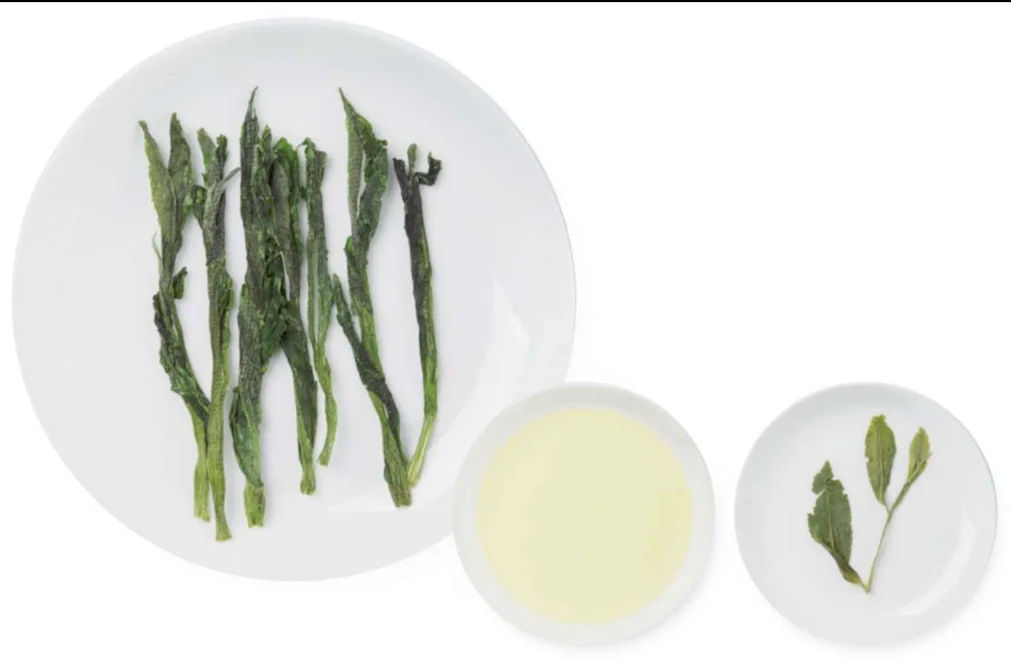
Its finished leaves can be dramatically long, flat and broad—sometimes several times larger than Longjing or Biluochun.
A classic piece often shows:
two leaves surrounding one bud
and a long, straight, blade-like form.
It barely looks like the tiny green tea many beginners expect.
Yet Taiping Houkui is absolutely a green tea.
That makes it one of the best teas for learning a central ChinaTea101 lesson:
Leaf size does not determine tea category or quality.
Quick Facts
| Chinese name | 太平猴魁 |
| Pinyin | Tàipíng Hóukuí |
| Tea type | Green tea |
| Origin | Huangshan District, Huangshan, Anhui |
| Famous core areas | Xinming, Longmen and Sankou |
| Main traditional cultivar | Shidacha 柿大茶 |
| Protected standard | GB/T 19698-2008 |
| Typical picking | Two leaves and one bud |
| Shape | Very long, flat and straight |
| Color | Deep muted green |
| Aroma | Fresh, high, often orchid-like |
| Taste | Fresh, mellow, sweet and full |
| Liquor | Clear pale green to yellow-green |
| Beginner temperature | About 85–90°C / 185–194°F |
The current Huangshan protection rules describe Taiping Houkui as a green tea produced within Huangshan District, mainly using Shidacha fresh leaves and processed through sorting, spreading, kill-green, shaping and multiple baking stages. (黄山政府网)
Where Does Taiping Houkui Come From?
Taiping Houkui comes from Huangshan District in Anhui Province.
Older descriptions often focus on:
Xinming
Longmen
and
Sankou
because these are famous production areas closely associated with high-quality Houkui.
They remain important today.
Huangshan government sources describe these three towns as key production areas, while the current municipal protection regulation defines the broader production area as Huangshan District as a whole. (黄山政府网)
So ChinaTea101 should distinguish between:
protected production region
and
famous core villages or towns.
They are related, but they are not exactly the same thing.
What About Houkeng?
The name:
猴坑 — Hóukēng
or Houkeng
appears constantly in discussions of premium Taiping Houkui.
Houkeng is a historic core production locality in today’s Xinming area.
Nearby places such as Houcun, Hougang and Yanjia are also identified by current Huangshan sources as core production areas. (黄山政府网)
So when you see:
Houkeng Taiping Houkui
the seller is making a much more specific origin claim than simply:
Taiping Houkui from Huangshan District.
And the more specific the claim becomes, the more provenance evidence you should expect.
What Does “Taiping Houkui” Mean?
The name is often translated loosely into English as:
Monkey King Tea
because:
猴 — hóu — monkey
and
魁 — kuí — chief, champion or leader
But the historical name is more interesting than the literal translation.
“Taiping” refers to the historic locality.
“Hou” is traditionally associated with Houkeng.
And “Kui” is connected with Kui Jian, a style of high-quality pointed tea.
So “Monkey King” is memorable English marketing, but it does not fully explain how the historical Chinese name developed.
When Was Taiping Houkui Created?
Taiping Houkui is much younger than China’s oldest tea traditions.
Huangshan government sources place its creation in the late Qing dynasty, during the Guangxu period. (黄山政府网)
You will find different local stories about exactly who created it.
Some traditions emphasize tea makers and merchants from Houkeng and members of the Fang family.
Other accounts include Wang Kuicheng or his family in the early development of the distinctive Kui Jian style.
The Ministry of Commerce’s historic-brand archive records another lineage involving Fang Nanshan, Fang Xiangui and others around the turn of the 20th century. (老字号数字博物馆)
ChinaTea101 therefore treats this as:
a late-Qing/early-20th-century tea tradition with several local origin narratives
rather than pretending there is one universally documented inventor.
That is historically safer.
LOOK — What Does Taiping Houkui Look Like?
This is one of the most visually distinctive teas in China.
Typical high-quality Taiping Houkui is:
very long
broad
flat
straight
and
substantial
rather than tiny and delicate.
The classic picking appearance is:
Two leaves and one bud
Chinese descriptions sometimes call this:
两叶抱一芽
meaning roughly:
two leaves embracing one bud.
Current Huangshan regulations explicitly include this two-leaf-one-bud appearance among Taiping Houkui’s characteristic qualities. (黄山政府网)
How Long Are the Leaves?
Some finished pieces can reach roughly:
5–8 cm
and sometimes longer depending on the material.
Do not turn that measurement into a rigid authenticity rule.
Tea is a plant.
Individual leaves vary.
The important visual impression is that Taiping Houkui is unusually long and broad compared with most famous Chinese green teas.
Why Are the Leaves So Large?
Taiping Houkui is not produced from the tiny unopened buds favored by some early-spring green teas.
It traditionally uses more developed shoots.
The local cultivar and picking standard allow the leaves to become substantially larger while still remaining tender enough for premium processing.
This is another excellent example of why:
big leaf does not mean low grade.
For Taiping Houkui, large leaf form is part of the expected style.
The Shidacha Cultivar
Current Huangshan regulations identify:
柿大茶 — Shidacha
as the principal traditional tea-tree variety used for Taiping Houkui. (黄山政府网)
Cultivar matters here because the distinctive large shoots, leaf structure and processing suitability begin with the plant material itself.
But cultivar alone does not create Houkui.
Fresh leaf must still be harvested and processed according to the appropriate regional method.
Again:
plant + place + processing
work together.
What Is the “Red Thread”?
One unusual feature you may notice is that the main vein of some leaves shows a dark reddish tone.
Traditional descriptions call this:
红丝线 — hóng sī xiàn
“red silk thread.”
Huangshan government descriptions specifically mention a dark reddish main vein as a characteristic visual feature of Taiping Houkui. (黄山政府网)
But this needs one important warning:
A red vein does not prove authenticity.
Color can vary with raw material and processing.
Use it as one observation—not as a certification system.
Are White Hairs Normal?
Yes.
Taiping Houkui can show fine pale tea hairs, although they are often more subdued than the spectacular fuzz seen on Biluochun.
Official descriptions mention:
白毫
or fine tea hairs.
They may lie close against the leaf surface rather than sticking out dramatically. (黄山政府网)
So:
white hairs can be normal,
but
more hair does not automatically mean better Houkui.
What About Grid Marks on the Leaves?
You may see faint texture or pressed patterns on some finished or brewed Taiping Houkui leaves.
These can result from shaping methods and contact with cloth, screens or equipment.
However:
Grid marks are not a universal authenticity test.
Traditional and modern processing methods can leave different surface textures.
If an online seller says:
“You can prove real Houkui because every leaf has exactly the same grid pattern,”
be cautious.
A manufacturing mark is not geographical proof.
SMELL — What Does Taiping Houkui Smell Like?
Taiping Houkui is particularly famous for a high, elegant aroma often described as:
兰香 — lán xiāng
orchid-like fragrance
Official Huangshan descriptions characterize it with a fresh, high aroma and orchid character. (黄山政府网)
Depending on the tea, you may also notice:
fresh greens,
sweet flowers,
soft bean-like notes,
gentle roasting,
or a light nutty character.
The aroma should feel clean and integrated.
It should not smell like artificial perfume.
Does Real Taiping Houkui Have to Smell Like Orchids?
No.
“Orchid aroma” is a traditional sensory description.
It does not mean every cup will smell exactly like a fresh orchid flower.
Aroma changes with:
cultivar,
season,
weather,
processing,
storage,
and brewing.
Treat orchid-like as a useful reference rather than a pass/fail test.
How Is Taiping Houkui Made?
Current Huangshan descriptions summarize the craft through steps including:
picking
↓
sorting the shoots
↓
spreading
↓
kill-green
↓
shaping
↓
baking
with baking traditionally divided into several stages. (黄山政府网)
Shaping is especially important because it creates the spectacular flat, straight leaf form.
The finished leaf does not naturally grow as a perfectly flat strip.
Tea makers create that appearance.
Why Does Processing Matter So Much?
Put an unprocessed Houkui shoot next to the finished tea and they do not look the same.
Heat changes the chemistry.
Shaping changes the form.
Drying changes aroma, stability and texture.
This makes Taiping Houkui another perfect example of our Lesson 8 principle:
Processing creates flavor — and shape.
Taiping Houkui Craft and UNESCO
Taiping Houkui’s traditional making technique is one of the Chinese tea-making traditions included within:
Traditional Tea Processing Techniques and Associated Social Practices in China
which UNESCO inscribed on its Representative List of the Intangible Cultural Heritage of Humanity in 2022.
Huangshan government specifically identifies Taiping Houkui, Huangshan Maofeng and Keemun black tea as the city’s three tea-making traditions included in that heritage system. (黄山政府网)
This recognizes the cultural knowledge behind the tea.
It does not mean every commercial packet is entirely handmade.
BREW — How to Brew Taiping Houkui
Taiping Houkui is unusual among green teas because its relatively large, sturdy leaves can tolerate somewhat hotter water than extremely delicate bud teas.
A good beginner starting point is:
| Parameter | Starting Point |
|---|---|
| Tea | 3–4 g |
| Water | 180–220 ml |
| Temperature | 85–90°C / 185–194°F |
| First infusion | About 60–90 seconds |
| Vessel | Tall clear glass or gaiwan |
Do not treat 90°C or two minutes as sacred numbers.
Start there and adjust.
Why Use a Tall Glass?
Few teas reward a tall glass as much as Taiping Houkui.
The leaves are spectacular.
Place several long leaves vertically in the glass.
Add water gently.
As they absorb water, the large flat leaves begin to loosen and stand, sink or float through the glass.
Eventually the two-leaf-and-bud structure becomes much easier to see.
For Taiping Houkui:
brewing is also visual education.
Do You Need to Arrange the Leaves by Hand?
Some ceremonial presentations carefully align the long leaves with their bases downward before adding water.
You can do this for visual effect.
But it is not necessary to make good tea.
ChinaTea101 does not want beginners believing:
“If I don’t line up every leaf perfectly, I’ve brewed it wrong.”
Taste matters more than choreography.
Should You Use 90°C Water?
Around 85–90°C is a sensible starting range.
Because the leaves are relatively substantial, slightly hotter water can help extract aroma and body.
But if your tea becomes:
too bitter,
too drying,
or flat,
reduce:
temperature,
leaf quantity,
or infusion time.
There is no prize for forcing every Taiping Houkui through exactly the same recipe.
Does It Need to Be Rinsed?
Usually no.
As with other delicate green teas, throwing away the first infusion is generally unnecessary.
The first water extracts important fragrance and flavor.
A brief pre-wetting step can be used for brewing control or leaf display, but that is different from “washing away dirt.”
TASTE — What Does Taiping Houkui Taste Like?
A good Taiping Houkui may combine:
freshness
sweetness
mellow body
floral fragrance
gentle green notes
and
a clean returning sweetness.
Official descriptions emphasize:
甘醇 — sweet and mellow
rather than aggressive bitterness. (黄山政府网)
The surprising part is that such huge leaves can still produce an elegant cup.
That contrast is one reason this tea is so memorable.
Is Taiping Houkui Never Bitter?
No.
This is one claim from the source material that should not become a rule on ChinaTea101.
You may hear that genuine Houkui:
“will not become bitter even if you use twice as much leaf.”
That is too absolute.
Any tea can become unpleasantly strong under sufficiently aggressive brewing.
A good Houkui may indeed tolerate generous brewing well.
But bitterness and astringency still depend on:
leaf quantity,
temperature,
water chemistry,
steep time,
and the tea itself.
So:
“Never bitter” is marketing language, not an authentication test.
Is It Really Good for Four Infusions?
Good-quality Taiping Houkui is traditionally praised for retaining aroma across several infusions.
One local saying describes:
first infusion — strong aroma
second — fuller flavor
third and fourth — lingering fragrance
This kind of description appears in traditional and industry material. (中国合作社发展委员会)
It is useful as an expectation.
But again:
four infusions does not prove authenticity.
Some excellent tea may fade earlier depending on brewing.
Some mediocre tea may still produce colored water for many rounds.
Judge what each infusion actually tastes like.
What Color Should the Liquor Be?
Expect something around:
clear pale green
yellow-green
or
light green-gold
rather than neon emerald.
Official descriptions use language such as clear tender green liquor. (黄山政府网)
Do not judge quality by saturation.
A clean, bright cup is more meaningful than an artificially intense color.
READ THE LEAVES
This is where Taiping Houkui becomes spectacular.
After brewing, take several leaves out and spread them on a white plate.
Look for:
two leaves and one bud
large intact leaves
supple texture
green to yellow-green color
clear main veins
and sometimes:
a reddish tone along the central vein.
The wet leaves should make the original picking structure easier to understand.
Can the Wet Leaves Prove Authenticity?
No.
They can help you judge whether the raw material is plausible for Taiping Houkui.
But they cannot prove:
Houkeng village,
Xinming town,
specific mountain,
specific farm,
or geographical-indication status.
Again:
Leaves can provide morphological evidence. They cannot provide GPS coordinates.
Why Is Fake or Imitation Houkui Easy to Make?
The style is visually famous.
Long, flattened green leaves are easy to recognize in photographs.
That gives sellers a strong incentive to imitate the appearance.
Related local Jiancha or other large-leaf green teas can sometimes be made or marketed in ways that resemble Taiping Houkui.
The problem is that a photograph may show:
long leaves,
flat leaves,
green leaves,
and even reddish veins,
without proving protected origin.
So when the tea is expensive, provenance matters.
Taiping Houkui vs “Jiancha”
Historically, the Houkui tradition developed out of the broader local world of:
尖茶 — Jiancha
or pointed teas.
Houkui eventually became distinguished as a particularly prestigious regional style.
That history helps explain why a visually similar pointed tea from surrounding areas should not automatically be sold as premium Houkeng Taiping Houkui.
Similarity is not identity.
How to Buy Authentic Taiping Houkui
For an inexpensive tea bought simply to learn the style:
do not overcomplicate the purchase.
But if you are paying a premium for:
authentic Taiping Houkui
Houkeng origin
or
core-area tea
check more carefully.
Look for:
producer,
production area,
harvest,
cultivar if stated,
GI labeling,
and traceability.
Huangshan District currently uses geographical-indication traceability systems in core areas, including one-product-one-code identification in Houcun, Hougang and Yanjia. (黄山政府网)
That evidence is much stronger than:
“Look, the leaf has a red vein.”
The National Standard
Taiping Houkui currently has a national geographical-indication product standard:
GB/T 19698-2008
Product of Geographical Indication — Taiping Houkui Tea
The national standards platform shows that it was reviewed again on August 4, 2025 and the conclusion was:
continue in force. (全国标准信息公共服务平台)
This is useful for ChinaTea101 because it lets us separate:
traditional descriptions
from
formal product definitions.
Both matter.
But they serve different purposes.
Taiping Houkui vs Longjing
Both are famous Chinese green teas, yet visually they are almost opposites.
| Taiping Houkui | Longjing | |
|---|---|---|
| Shape | Very long and flat | Shorter, flat spear-like leaves |
| Picking | Commonly two leaves and one bud | Tender buds and young leaves |
| Leaf size | Very large | Much smaller |
| Aroma | Floral/orchid-like, fresh | Nutty, bean-like, chestnut |
| Body | Often fuller | Usually more delicate |
| Vessel | Tall glass works beautifully | Glass also popular |
The comparison makes one thing obvious:
“flat green tea” is not one style.
Taiping Houkui vs Lu’an Guapian
Both come from Anhui.
Both can have much larger leaves than tiny-bud teas.
But they teach opposite lessons.
Taiping Houkui
Preserves an obvious:
two leaves + one bud shoot structure.
Lu’an Guapian
Traditionally removes:
bud + stem
and uses individual leaves.
So even two large-leaf Anhui green teas can use completely different raw-material philosophies.
Taiping Houkui vs Xinyang Maojian
Xinyang Maojian:
fine,
narrow,
needle-like,
often hairy.
Taiping Houkui:
broad,
long,
flat,
and dramatically large.
Put them together and a beginner may struggle to believe both are green tea.
That is exactly why they belong together in the ChinaTea101 atlas.
Taiping Houkui vs Biluochun
Biluochun is:
tiny,
curled,
spiral-shaped,
and covered in fine hairs.
Taiping Houkui is:
giant,
flat,
straight,
and broad.
Again:
same broad category, completely different physical expression.
Chinese green tea is a processing category—not a shape.
Common Beginner Mistakes
The biggest mistakes are assuming that longer leaves automatically mean better Houkui; treating every reddish vein as proof of authenticity; believing every tea from Xinming is automatically top grade; using boiling water for several minutes and blaming the leaf; and treating “four infusions of orchid aroma” as a laboratory test.
Instead, combine:
shape
shoot structure
aroma
taste
wet leaves
and
provenance.
The ChinaTea101 Method
LOOK
Are the leaves exceptionally long, flat and straight?
Can you see the expected two-leaf-one-bud structure?
SMELL
Is the aroma clean, high and floral?
Do you notice an orchid-like quality?
BREW
Start around 85–90°C.
Give the large leaves enough time to open without overextracting them.
TASTE
Look for freshness, sweetness, body and aftertaste.
Do not demand zero bitterness under every brewing condition.
READ THE LEAVES
Can you see the large leaf structure clearly?
Are the leaves supple and plausible for the style?
CHECK PROVENANCE
Does the seller’s evidence support the specific origin being claimed?
That final step matters when buying expensive Houkeng or core-area tea.
ChinaTea101 Rule
Taiping Houkui may be one of the easiest Chinese teas to recognize visually.
But:
Easy to recognize is not the same as easy to authenticate.
Long flat leaves tell you:
“this resembles Taiping Houkui.”
They do not tell you:
“this definitely came from Houkeng.”
For that, you need provenance.
FAQ
What is Taiping Houkui?
Taiping Houkui is a famous Chinese green tea from Huangshan District, Anhui, known for unusually long, flat leaves and a characteristic two-leaves-and-one-bud appearance.
Where does Taiping Houkui come from?
Current Huangshan regulations define Huangshan District as its production area. Xinming, Longmen and Sankou are important production towns. (黄山政府网)
Is Houkeng the only authentic production area?
No. Houkeng is an especially famous core origin, but the protected Taiping Houkui production area is broader.
What tea plant is used for Taiping Houkui?
Current local regulations identify Shidacha (柿大茶) as the main traditional cultivar. (黄山政府网)
Why are Taiping Houkui leaves so large?
Its picking standard uses more developed shoots, traditionally showing two leaves around one bud, rather than only tiny unopened buds.
What does Taiping Houkui taste like?
It is commonly described as fresh, sweet, mellow and full, with a high floral or orchid-like aroma.
What is the “red thread” in Taiping Houkui?
Some leaves show a reddish central vein, traditionally called hong si xian, or “red silk thread.” It is a useful characteristic but not proof of authenticity. (黄山政府网)
Does authentic Taiping Houkui have grid marks?
Some processing and shaping methods can leave surface textures, but grid marks are not a universal authentication rule.
What temperature should I use?
About 85–90°C / 185–194°F is a good starting range.
How long should I brew Taiping Houkui?
Start around one minute and adjust according to leaf quantity, vessel and taste.
Should I rinse it?
Usually no.
Is Taiping Houkui never bitter?
No. Good tea may be forgiving, but any green tea can become bitter or astringent if brewed too aggressively.
Can Taiping Houkui last four infusions?
High-quality tea can retain pleasant aroma over several infusions, but a fixed number of infusions is not an authenticity test.
Is orchid aroma proof that the tea is genuine?
No. Orchid-like fragrance is a traditional sensory description, not a geographical certificate.
Is Taiping Houkui a geographical-indication product?
Yes. The current national standard is GB/T 19698-2008, which remained valid after its 2025 review. (全国标准信息公共服务平台)
Is Taiping Houkui part of UNESCO tea heritage?
Its traditional production technique is included within China’s tea-processing traditions inscribed on UNESCO’s Representative List in 2022. (黄山政府网)
Who invented Taiping Houkui?
Local historical accounts differ. Official Huangshan sources place its creation in the late Qing Guangxu period, while different lineages credit several tea makers and merchants in its early development. (黄山政府网)
How is Taiping Houkui different from Huangshan Maofeng?
They’re separate protected teas from the same general Mt. Huangshan area, distinguished mainly by shape: Taiping Houkui’s standard defines a large, flat “two leaves embracing one bud” form, while Huangshan Maofeng is shaped into a much smaller sparrow-tongue form.
Sources & review status
- taiping-houkui.md — Owner-supplied editorial draft. Longform owner-supplied draft; citation rendering fixed and content reviewed against site fact-check patterns during the V1 publication QA pass.
Imported from taiping-houkui.md. Updated 2026-09-19. Last reviewed 2026-09-25
How we check claims