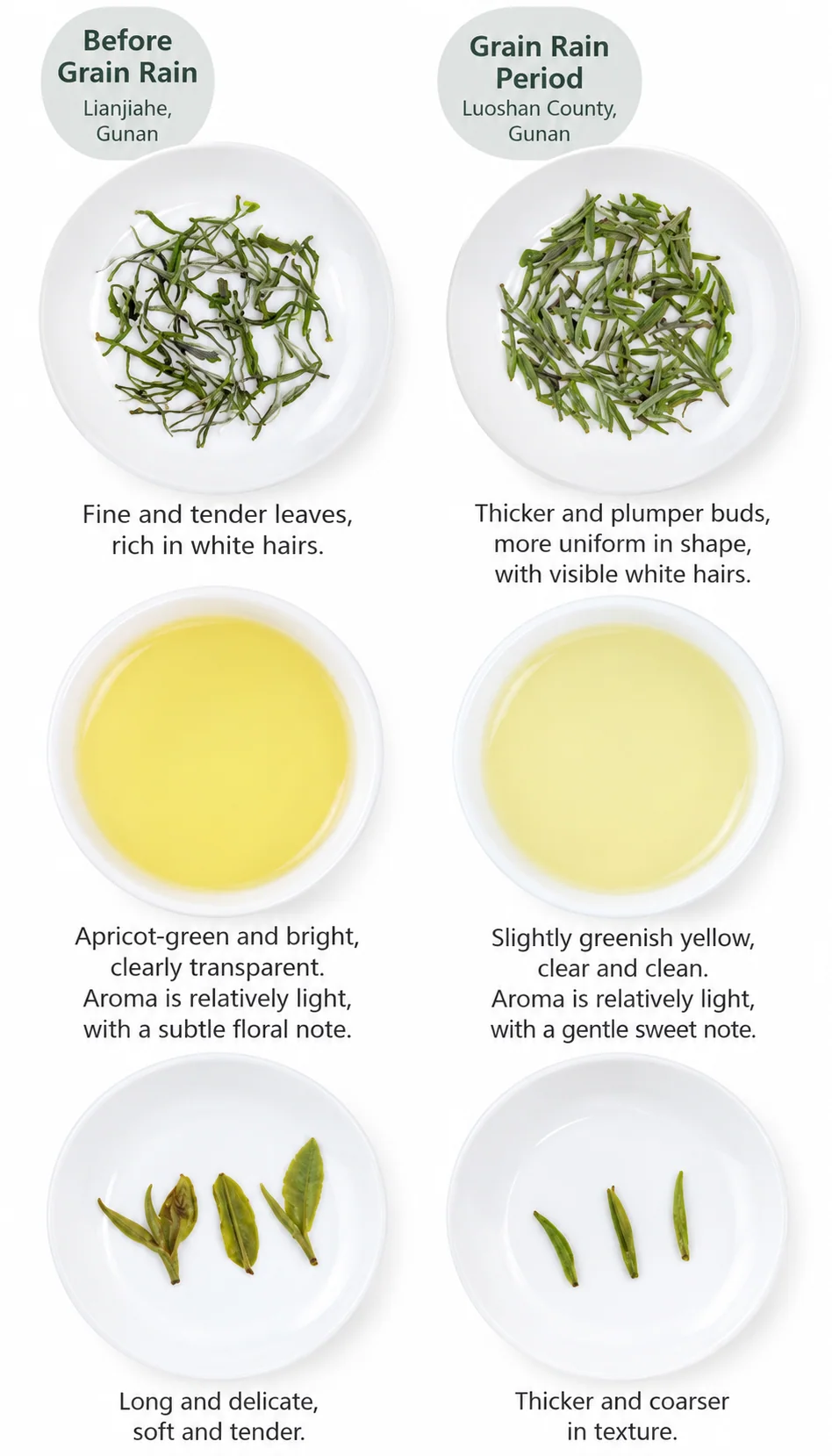
Premium green tea does not always mean tiny buds.
Many famous Chinese green teas compete for tenderness.
Longjing prizes tender spring shoots.
Biluochun is famous for tiny curled buds and young leaves.
Xinyang Maojian can be covered in fine hairs from very tender material.
Then comes Lu’an Guapian.
It does something almost opposite.
Traditional Lu’an Guapian production removes the buds and stems and uses individual leaves.
That unusual choice gives the tea a completely different visual identity and helps produce a fuller, more substantial cup.
The name is written:
六安瓜片 — Lù’ān Guāpiàn
It is often translated into English as:
Lu’an Melon Seed Tea
because the finished leaves are traditionally said to resemble melon seeds.
Quick Facts
| Chinese name | 六安瓜片 |
| Pinyin | Lù’ān Guāpiàn |
| Tea type | Green tea |
| Origin | Lu’an, Anhui, China |
| Protected area | Parts of 5 districts/counties and 26 towns in Lu’an |
| Current GI standard | DB34/T 237-2017 |
| Leaf material | Individual leaves; buds and stems traditionally removed |
| Typical shape | Flat single leaves with slightly curled edges |
| Typical color | Deep jade or “frosted” green |
| Typical aroma | Fresh, high, clean, lightly roasted |
| Liquor | Clear yellow-green to green |
| Taste | Fresh, mellow, full, returning sweetness |
| Beginner water temperature | About 80–85°C / 176–185°F |
Where Does Lu’an Guapian Come From?
Lu’an Guapian comes from western Anhui, around the Dabie Mountain region.
Although Jinzhai County is one of its best-known producing areas, authentic geographical-indication Lu’an Guapian is not limited to Jinzhai.
The legally protected production area includes specified towns in:
Jinzhai County, Yu’an District, Huoshan County, Jin’an District and Shucheng County.
In total, the GI announcement identifies 26 towns within these five administrative areas. (明扬电脑)
This distinction matters for buyers.
A package that says:
“Lu’an Guapian from Jinzhai”
can be perfectly plausible.
But:
“All authentic Lu’an Guapian must come from Jinzhai”
would be incorrect.
What Makes Lu’an Guapian So Unusual?
The most important thing to understand is its raw material.
Traditional production removes:
the bud
and
the stem
and processes the remaining leaf as an individual piece.
Lu’an’s cultural authorities describe it as the distinctive Chinese green tea made from single leaves without buds or stems. (六安市文化和旅游局)
This is why it is sometimes called:
片茶 — Piàn Chá
“leaf-piece tea” or “single-leaf tea.”
For a beginner, this immediately challenges a common assumption:
Smaller buds are always better.
Not in every tea.
Lu’an Guapian deliberately builds its identity around mature leaf material.
Why Remove the Buds and Stems?
The goal is not simply to make the tea look unusual.
Removing the bud and stem changes the raw material going into processing.
Local descriptions traditionally associate this with a fuller but cleaner flavor profile and with preserving the distinctive single-leaf shape. (杭州网)
The result is a green tea that may feel more substantial than extremely bud-heavy spring teas.
This gives ChinaTea101 an important lesson:
Tenderness is not the same thing as quality.
Different tea styles need different raw material.
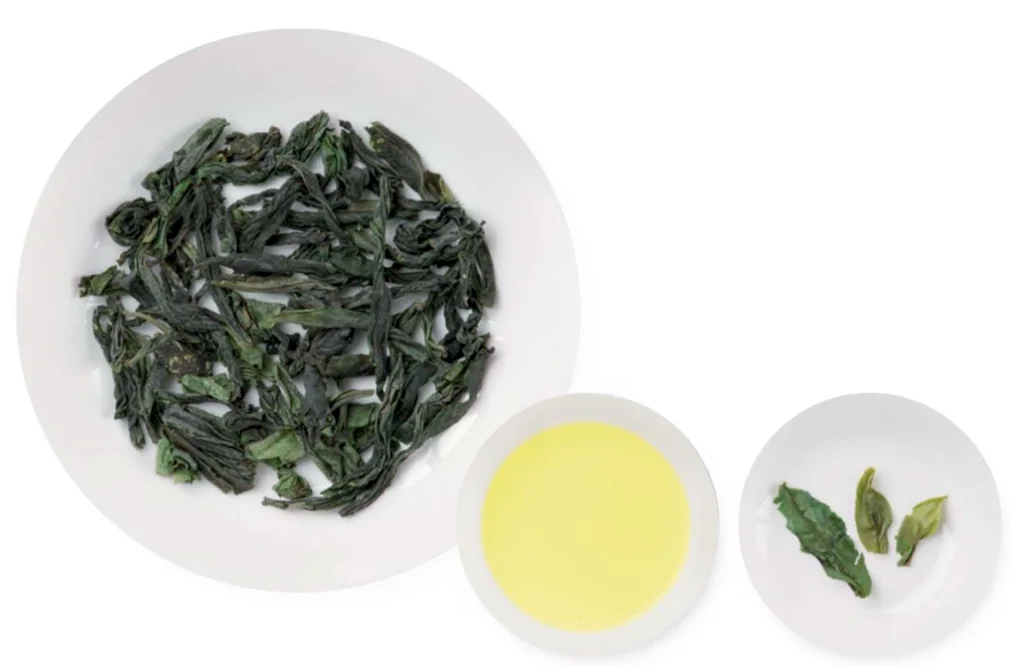
LOOK — What Does Lu’an Guapian Look Like?
The finished tea should not look like a pile of tiny buds.
Instead, look for relatively complete single leaves.
Typical characteristics include:
larger leaf pieces
fairly even size
a flattened or naturally curved shape
slightly raised or curled edges
deep jade-green color
and sometimes a subtle pale “frosted” surface appearance.
Official Lu’an descriptions characterize the leaves as flat and straight, shaped somewhat like melon seeds, jade-green in color and slightly frosted. (六安市文化和旅游局)
Why Is It Called “Guapian”?
Gua — 瓜 means melon.
Pian — 片 means slice or piece.
The finished dry leaf is traditionally compared to:
瓜子片 — melon-seed-shaped pieces.
Do not take the comparison too literally.
A real leaf is still an irregular biological object.
If every piece looks machine-cut into an identical geometric “melon seed,” that is not necessarily a sign of superior tea.
Natural variation is normal.
What Is the White “Frost” on Lu’an Guapian?
Traditional descriptions sometimes mention:
白霜 — white frost
on the finished leaf.
This does not mean the tea has been coated in sugar or should look visibly white.
It refers to a subtle pale surface effect associated with proper firing and drying.
Local descriptions specifically mention the characteristic slightly frosted appearance of the finished leaves. (六安市文化和旅游局)
And importantly:
White frost is not automatically mold.
Mold has different texture, odor and growth patterns.
The tea must always be assessed as a whole.
SMELL — What Does Lu’an Guapian Smell Like?
A good Lu’an Guapian can show a clean, high green-tea fragrance.
Depending on grade and roasting, you may notice impressions such as:
fresh greens,
light roasted nuts,
warm grain,
sweet vegetation,
gentle flowers,
and a clean fired aroma.
Because its processing includes substantial heat work, the fragrance can feel somewhat warmer than that of an extremely delicate steamed green tea.
But it should not smell burnt.
The Importance of Fire
Lu’an Guapian’s processing is unusually important to its identity.
Traditional production includes stages commonly described as:
picking,
separating the leaf,
first pan firing,
second pan firing,
initial drying,
intermediate firing,
and final high firing.
The famous final stage is known as:
拉老火 — Lā Lǎo Huǒ
roughly:
final high-fire drying
or
pulling the old fire.
Local official sources describe this as one of the most distinctive parts of the craft and an important contributor to the tea’s color, aroma, taste and shape. (六安市文化和旅游局)
What Happens During “La Lao Huo”?
In traditional production, tea-filled drying baskets are repeatedly moved over strong charcoal heat.
The tea is heated briefly, removed, turned and heated again.
This cycle may be repeated many times.
The goal is controlled finishing—not burning.
The process helps reduce moisture, stabilize the tea and build the characteristic aroma.
This is why Lu’an Guapian is an excellent example of the Lesson 8 principle:
Processing creates flavor.
The leaf alone does not create the finished tea.
Lu’an Guapian and UNESCO Tea Heritage
Lu’an Guapian’s traditional production technique was listed as a national intangible cultural heritage item in China in 2008.
In 2022, its craft was also included as part of China’s Traditional Tea Processing Techniques and Associated Social Practices, inscribed on UNESCO’s Representative List of the Intangible Cultural Heritage of Humanity. (六安市文化和旅游局)
This means the craft itself has recognized cultural significance.
It does not mean every packet sold as Lu’an Guapian was entirely handmade.
Modern production can include mechanized processes as well.
BREW — How to Brew Lu’an Guapian
Because Lu’an Guapian uses more substantial leaf material than many tiny-bud green teas, it can usually tolerate slightly more assertive brewing.
A useful starting point is:
| Parameter | Starting Point |
|---|---|
| Tea | 3–4 g |
| Water | 150–200 ml |
| Temperature | 80–85°C / 176–185°F |
| First infusion | about 30–45 seconds |
| Vessel | White porcelain gaiwan or clear glass |
You can increase the temperature slightly if the tea tastes too thin.
Decrease it if bitterness becomes dominant.
The Middle-Pour Method
Lu’an Guapian is often brewed using:
中投法 — Zhōng Tóu Fǎ
or:
middle-pour method.
The sequence is approximately:
some water first
→
add the tea
→
allow the leaves to become wet
→
fill with the remaining water.
This is different from putting dry tea into an empty vessel and immediately blasting it with a full pour of hot water.
For green tea, the more controlled approach can help avoid harsh extraction.
Does Lu’an Guapian Need to Be Rinsed?
Usually not.
There is little reason to discard the first infusion of a good green tea just because of a general “tea washing” habit.
You may briefly moisten the leaves as part of the brewing technique.
But that is different from throwing the first cup away.
With Lu’an Guapian, the first extraction contains plenty of aroma and flavor.
Why Use a White Porcelain Gaiwan?
White porcelain makes this tea easy to study.
You can see:
the yellow-green liquor,
the changing leaf color,
and the large single leaves opening.
It also does not add another material aroma to the tea.
A glass works well too.
But the gaiwan makes it particularly easy to control infusion time.
TASTE — What Does Lu’an Guapian Taste Like?
A well-made Lu’an Guapian often feels:
fresh
mellow
fuller than very delicate bud teas
clean
and
sweet in the finish.
The Chinese phrase:
鲜醇回甘
is useful here.
It combines the ideas of:
freshness,
mellow body,
and returning sweetness.
The tea may have noticeable structure without feeling coarse.
Does Mature Leaf Mean Bitter Tea?
Not necessarily.
This is exactly why Lu’an Guapian is such a useful teaching tea.
Beginners often assume:
larger leaf = older leaf = rough tea = worse tea.
But raw-material maturity is only one variable.
Correct selection and skilled processing can create a clean, full and refreshing cup from leaf material that would look “too mature” beside Biluochun.
So:
Bigger leaf does not automatically mean lower quality.
It may simply mean the tea is designed differently.
What Color Should Lu’an Guapian Be?
The liquor is commonly described as:
clear yellow-green
or
bright greenish-yellow.
Do not expect a fluorescent green cup.
Real Chinese green tea often appears softer and more yellow than heavily edited product photographs.
Clarity and liveliness are usually more useful clues than extreme saturation.
READ THE LEAVES
Lu’an Guapian becomes especially educational after brewing.
Spread several leaves out on a white plate.
You should be able to see clearly that this tea is fundamentally different from bud-heavy green teas.
Look for:
broad leaf pieces,
no obvious long woody stems,
little or no intact terminal bud,
green or yellow-green color,
softness,
and relatively complete leaf structure.
This is one of the few famous Chinese green teas where seeing a larger mature leaf can actually make the tea look more correct rather than less premium.
Does Every Leaf Need to Be Perfect?
No.
Tea is an agricultural product.
Some breakage is normal.
The more useful question is whether the batch shows a consistent overall style.
If a supposed high-grade Lu’an Guapian is dominated by:
long stems,
large amounts of bud material,
tiny broken powder,
or completely unrelated leaf shapes,
then it deserves closer examination.
But one imperfect piece proves very little.
Lu’an Guapian vs Longjing
They are both famous Chinese green teas.
But visually they are very different.
| Lu’an Guapian | Longjing | |
|---|---|---|
| Main material | Single leaves | Tender buds and leaves |
| Buds | Traditionally removed | Often important |
| Stems | Removed | Short stems may remain with shoots |
| Shape | Melon-seed-like leaf pieces | Flat pressed shoots |
| Body | Often fuller | Usually softer/tender |
| Aroma tendency | Fresh, fired, clean | Nutty, bean-like, chestnut |
| Key lesson | Mature leaf can be premium | Tender spring shoots matter |
This comparison destroys the simplistic rule:
“The tea with the smallest buds must be better.”
Lu’an Guapian vs Biluochun
Biluochun is almost the opposite visually.
Biluochun:
tiny,
curled,
hairy,
very tender.
Lu’an Guapian:
larger,
leaf-based,
flat or slightly curled,
budless.
Both can be excellent.
That is exactly why learning tea by shape + raw material + processing is much more useful than learning by price alone.
Lu’an Guapian vs Xinyang Maojian
Xinyang Maojian is normally:
fine,
needle-like,
straight,
and often visibly hairy.
Lu’an Guapian is:
broad,
single-leaf,
melon-seed-like,
and usually much larger.
Put the dry leaves side by side and they barely look like the same category.
Yet both are green tea.
Again:
Tea category does not determine finished shape.
Is Lu’an Guapian Only From Jinzhai?
No.
This is one of the main things I would correct from the original Chinese material.
Jinzhai County contains famous traditional production areas, but the legal geographical-indication protection zone extends into several parts of Lu’an.
The official 2007 GI announcement covers specific towns across Jinzhai, Yu’an, Huoshan, Jin’an and Shucheng. (明扬电脑)
So on ChinaTea101 we should write:
Famous core areas include Jinzhai, but authentic Lu’an Guapian’s protected region is broader than one county.
How to Check Authentic Lu’an Guapian
Lu’an currently maintains a geographical-indication protection system.
Under the current local management rules, authorized producers must comply with the GI standard and can use the official geographical-indication mark only after approval. The rules also require the relevant standard or approved GI information to appear on labels or packaging. (六安市市场监督管理局)
For ordinary inexpensive tea, you do not need to turn every purchase into an investigation.
But when a seller charges a significant premium for:
authentic GI Lu’an Guapian
check:
origin,
producer,
grade,
harvest,
and GI labeling.
The more specific the claim, the more evidence you should expect.
Lu’an Tea vs Lu’an Guapian
This historical question is especially interesting.
The classic Chinese novel Dream of the Red Chamber mentions:
六安茶 — Lu’an tea
But that does not necessarily mean modern Lu’an Guapian.
“Lu’an tea” was historically a broader regional tea category.
Modern historical research places the evolution and naming of Lu’an Guapian much later, with the name becoming established around the late Qing or early Republican period. By contrast, Dream of the Red Chamber belongs to the 18th-century Qing context. (创新与中华)
Therefore ChinaTea101 should not simply write:
“The tea in Dream of the Red Chamber was Lu’an Guapian.”
A more historically careful version is:
The novel mentions Lu’an tea, an older regional tea tradition. Modern Lu’an Guapian developed from that broader Lu’an tea history, but the two terms should not automatically be treated as identical.
This is a much stronger page because it distinguishes cultural tradition from later product naming.
Why Historical Tea Names Are Difficult
Tea names evolve.
Production methods evolve.
Administrative boundaries change.
A famous regional tea mentioned 300 years ago may not correspond exactly to a product sold today under a modern geographical-indication standard.
So when an old text says:
Lu’an tea
ChinaTea101 asks:
Which period?
Which processing method?
Which leaf material?
Was the modern name already in use?
That prevents history from becoming marketing mythology.
Why Lu’an Guapian Matters in the Chinese Tea Atlas
Lu’an Guapian teaches one lesson better than almost any other famous green tea:
Premium does not always mean youngest.
China has famous teas built around tiny spring buds.
It also has an elite green tea built around carefully selected individual leaves.
That is a much richer way to understand Chinese tea.
The ChinaTea101 Method
When you taste Lu’an Guapian:
LOOK: Are there relatively complete single leaves rather than piles of buds and stems?
SMELL: Is the aroma clean, fresh and pleasantly fired?
BREW: Start around 80–85°C and keep the first infusion controlled.
TASTE: Look for freshness, body, cleanliness and returning sweetness.
READ THE LEAVES: Do the wet leaves make sense for a tea famous for leaf-only production?
Then check:
PROVENANCE: Does the origin claim match the protected Lu’an production area?
No single clue proves authenticity.
Several consistent clues are much more useful.
ChinaTea101 Rule
Do not judge a Chinese green tea by asking:
“How many buds does it have?”
Lu’an Guapian deliberately removes them.
Do not ask:
“Are the leaves extremely tiny?”
They should not be.
Instead ask:
Does the raw material make sense for this particular tea?
That is the difference between memorizing tea and actually learning how to identify it.
FAQ
What is Lu’an Guapian?
Lu’an Guapian is a famous Chinese green tea from Anhui, known for using individual leaves with the buds and stems traditionally removed.
What does Lu’an Guapian mean?
“Lu’an” is the producing region. “Guapian” means roughly “melon slice/piece,” referring to the melon-seed-like appearance of the finished leaf.
Is Lu’an Guapian made only from leaves?
Traditional production is famous for removing buds and stems and processing individual leaves. Lu’an official cultural sources describe it as unique among Chinese green teas in this respect. (六安市文化和旅游局)
Is Lu’an Guapian from Jinzhai County?
Jinzhai is an important production area, but the protected geographical-indication zone is broader and includes designated towns in five Lu’an districts/counties. (明扬电脑)
What does Lu’an Guapian taste like?
It is commonly described as fresh, mellow and full, with a clean aroma and lingering sweetness.
Why are the leaves larger than many premium green teas?
Lu’an Guapian intentionally uses opened leaf material rather than focusing on tiny buds.
Does larger leaf mean lower quality?
No. Raw-material standards differ from tea to tea.
What is the white frost on Lu’an Guapian?
It is a traditional description of a subtle pale surface appearance produced during finishing. It should not automatically be confused with mold.
What temperature should I use?
Around 80–85°C / 176–185°F is a useful starting point.
Should I rinse Lu’an Guapian?
Usually no.
What is the middle-pour brewing method?
A small amount of water is added first, then the tea, followed by the remaining water. This allows the leaves to wet more gently.
What is “La Lao Huo”?
It is the distinctive final high-fire drying stage used in traditional Lu’an Guapian manufacture. It plays an important role in developing the finished tea’s aroma and character. (六安市文化和旅游局)
Is Lu’an Guapian handmade?
Traditional handcraft is culturally important, but modern commercial production can also involve machinery. There are current local technical standards for both hand and mechanical processing. (全国标准信息公共服务平台)
Is the “Lu’an tea” in Dream of the Red Chamber Lu’an Guapian?
It is safer to say no, not in the modern product sense. Historical “Lu’an tea” was a broader category, while research places the modern Lu’an Guapian name around the late Qing/early Republican period. (创新与中华)
Is Lu’an Guapian protected by geographical indication?
Yes. The current protection system defines the production area and requires compliant producers to follow the applicable GI standard. (六安市市场监督管理局)
Sources & review status
- luan-guapian.md — Owner-supplied editorial draft. Longform owner-supplied draft; citation rendering fixed and content reviewed against site fact-check patterns during the V1 publication QA pass.
Imported from luan-guapian.md. Updated 2026-09-19. Last reviewed 2026-09-25
How we check claims