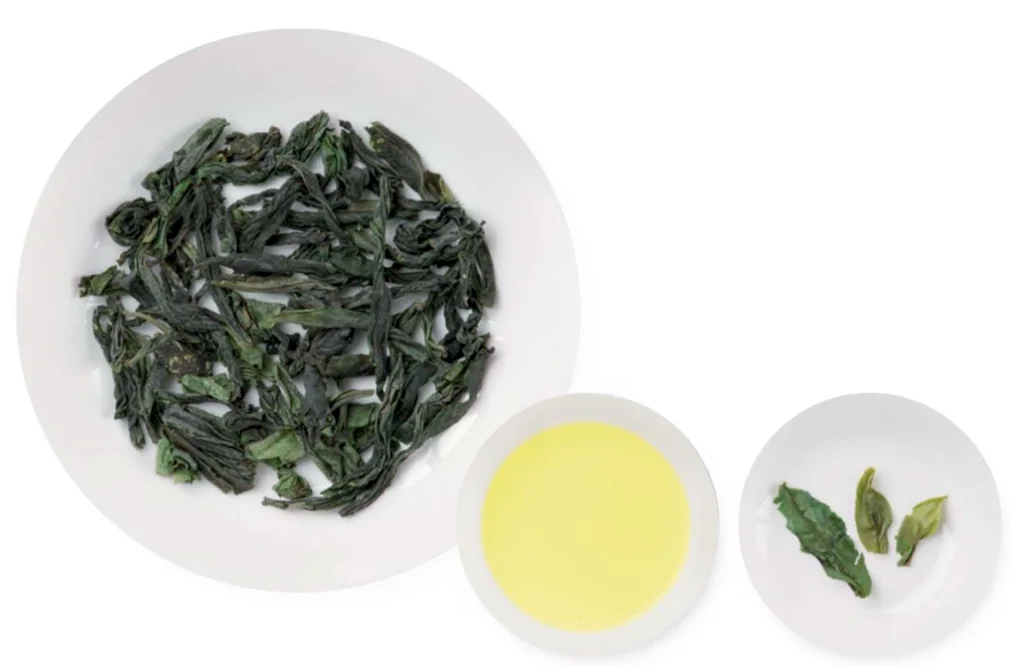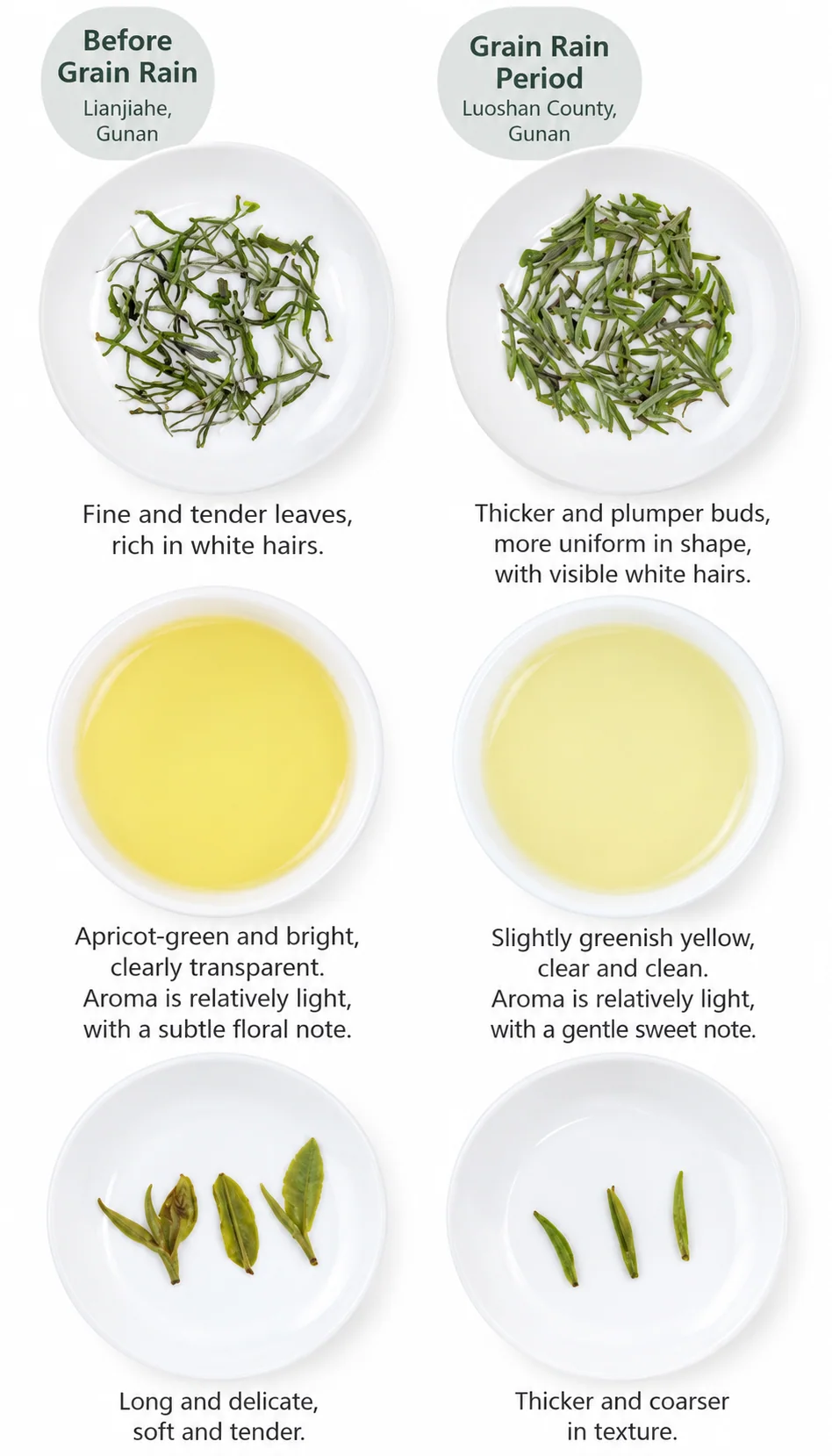
Fine hairs can explain some cloudiness; they cannot establish quality by themselves.
Xinyang Maojian (信阳毛尖) is one of China’s best-known green teas.
At first glance, it is easy to understand the name.
Mao — 毛 refers to the fine hairs that can appear on tender tea shoots.
Jian — 尖 means a pointed tip.
The finished tea is typically fine, tight and straight, with visible pale hairs on tender material.
But appearance is only the beginning.
Xinyang Maojian is also known for a distinctive combination of fresh green-tea character, sweetness, briskness and the roasted-nut aroma traditionally described as chestnut fragrance.
For a beginner learning Chinese green tea, it is especially useful because it teaches several important lessons at once:
leaf hairs are not mold,
slightly cloudy liquor is not automatically dirty,
spring harvest does not guarantee quality,
and a tea that looks delicate can extract surprisingly quickly.
Quick Facts
| Chinese name | 信阳毛尖 |
| Pinyin | Xìnyáng Máojiān |
| Tea type | Green tea |
| Origin | Xinyang, Henan, China |
| Protected standard | GB/T 22737-2008 |
| Typical form | Fine, tight, round and straight |
| Typical color | Silvery green to deep green |
| Typical aroma | Fresh, tender, nutty, chestnut-like |
| Liquor | Clear pale green to yellow-green |
| Typical taste | Fresh, brisk, sweet, lively |
| Best-known season | Spring |
| Beginner water temperature | About 80–85°C / 176–185°F |
Where Does Xinyang Maojian Come From?
Xinyang lies in southern Henan, around the transition between the Dabie Mountains and Tongbai Mountains.
Its tea-growing landscape is quite different from the stereotypical image of northern China.
The region is humid, mountainous and heavily vegetated.
The national geographical-indication standard describes Xinyang as lying in a climatic transition zone with substantial rainfall, humid conditions and tea gardens concentrated mainly on hilly and mountainous terrain. The GI protection area covers the administrative territory of Xinyang City. (国家标准网上公众服务平台)
Within that larger area, several famous mountain tea regions have traditionally received special attention.
You may encounter the expression:
“Five Clouds, Two Pools, One Mountain, One Village and One Temple.”
These names refer to celebrated tea-growing locations around Xinyang.
They are useful for understanding local tea culture.
But do not interpret them to mean:
“If the tea is not from one of these mountains, it cannot legally be Xinyang Maojian.”
The protected geographical area is broader.
Why Is Xinyang Unusual for Chinese Green Tea?
Xinyang is often described as one of China’s more northerly major tea-producing areas.
That gives it an interesting growing environment.
Cooler conditions, mountainous terrain and slower spring development can contribute to tender spring material.
Modern Xinyang government sources continue to emphasize mountain-grown spring tea and the region’s long-established tea economy. (信阳政府)
But ChinaTea101 does not use the shortcut:
high mountain = automatically high quality.
Cultivar, weather, harvest, processing and storage still matter.
LOOK — What Does Xinyang Maojian Look Like?
Traditional descriptions emphasize four characteristics:
Fine
Tight
Round
Straight
In Chinese this is often summarized as:
细、圆、光、直
The dry tea commonly appears as narrow, needle-like strands rather than flat leaves like Longjing or curled spirals like Biluochun.
Tender grades may also display many fine pale hairs.
Look for:
a relatively fine needle-like shape,
tight rolling,
natural variation rather than machine-perfect uniformity,
and visible tea hairs on tender material.
What Does “Maojian” Actually Mean?
The word Maojian appears in more than one Chinese tea name.
It does not mean every Maojian tea is Xinyang Maojian.
Other regions also produce teas using Maojian in the name.
So:
Maojian describes a style/name element. Xinyang Maojian identifies the specific protected regional tea.
This distinction is useful when shopping online.
A package saying only:
Maojian Green Tea
should not automatically be interpreted as genuine Xinyang Maojian.
The Traditional “Crow’s Beak” Description
You may encounter an unusual traditional phrase used to describe Xinyang Maojian:
鸦雀嘴
literally something like:
“crow’s beak.”
This is visual shorthand.
It refers to the pointed, compact appearance of properly made young leaf material.
It should not be treated as a scientific grading rule.
Tea traders often develop memorable visual expressions like this because they make characteristics easier to remember.
ChinaTea101 uses them as clues, not proof.
What Are the White Hairs?
Like Biluochun and many other tender spring teas, Xinyang Maojian can show fine plant hairs called:
茶毫 — chá háo
or tea trichomes.
These are naturally present on young buds and leaves.
So visible white fuzz does not automatically mean:
dust,
contamination,
or mold.
It can be completely normal.
But here again:
more hair does not automatically mean better tea.
Picking standard, cultivar and processing all influence how visible the hairs become.
SMELL — The Famous Chestnut Aroma
One of the most famous descriptions of Xinyang Maojian is:
板栗香 — bǎn lì xiāng
chestnut aroma
This does not mean chestnuts are added to the tea.
It describes a roasted, nutty aroma that can develop through green-tea processing.
Depending on the tea, you may notice:
fresh greens,
roasted chestnut,
warm nuts,
flowers,
sweet vegetal notes,
or a clean tender aroma.
The aroma should feel integrated with the tea rather than like added flavoring.
The Traditional Three-Part Description
You may also encounter a local phrase linking Xinyang Maojian with:
鸦雀嘴 — crow’s-beak shape
板栗香 — chestnut aroma
and
绿豆汤 — “mung-bean soup” liquor
The last phrase sounds strange in English.
It does not mean that Xinyang Maojian should literally taste like a bowl of sweet mung-bean soup.
It is a traditional visual and sensory shorthand for a soft greenish-yellow liquor and fresh, mellow impression.
This is exactly the kind of Chinese tea expression that should be explained rather than translated word for word.
BREW — How to Brew Xinyang Maojian
Xinyang Maojian can extract quickly.
A useful beginner recipe is:
| Parameter | Starting Point |
|---|---|
| Tea | 3 g |
| Water | 150–200 ml |
| Temperature | 80–85°C / 176–185°F |
| First drinking point | about 30–60 seconds |
| Vessel | Clear glass or gaiwan |
A transparent glass is especially useful for beginners because you can observe the fine leaf strands, suspended hairs and gradual opening of the tea.
Does Xinyang Maojian Need to Be Rinsed?
Usually, no.
There is little reason to throw away the first infusion of a delicate green tea simply because it is called “washing the tea.”
If you want, you can use a small amount of warm water to briefly moisten the leaves before filling the glass.
But that is a brewing technique—not a sanitation requirement.
With good-quality green tea, the first extraction contains important aroma and flavor.
A Simple Glass-Brewing Method
Place the tea in a clean glass.
Add a small amount of approximately 80–85°C water.
Gently rotate or tilt the glass so the leaves become evenly wet.
Then add the remaining water.
Start tasting early.
Do not wait automatically for three or five minutes.
Xinyang Maojian can release flavor surprisingly quickly.
Why Is My First Infusion Bitter?
The source material you provided describes the first infusion as sometimes noticeably bitter, with later infusions becoming softer.
That can happen.
But ChinaTea101 does not want users to believe:
“Authentic Xinyang Maojian should have a bitter first cup.”
If your first infusion is strongly bitter, check:
water temperature,
leaf quantity,
and steeping time.
A brisk edge can be part of the tea.
Severe harshness does not need to be accepted as a sign of authenticity.
Try slightly cooler water or begin drinking earlier.
TASTE — What Does Xinyang Maojian Taste Like?
A well-brewed cup may combine:
freshness
sweetness
briskness
nutty or chestnut-like aroma
gentle floral notes
and
a clean lingering finish
The tea can feel more assertive than some extremely delicate green teas.
That does not necessarily mean it is coarse.
Its character often comes from the balance between:
fresh green flavor,
slight bitterness,
light astringency,
and returning sweetness.
What Color Should the Liquor Be?
Traditional descriptions often refer to an:
apricot-green
or
clear yellow-green
liquor.
Do not expect neon green.
Real green tea is frequently much more yellow than online product photography suggests.
Depending on harvest and brewing, the liquor may range from:
pale green,
to yellow-green,
to light golden-green.
Very saturated color is not a quality requirement.
Why Can the Tea Look Slightly Cloudy?
Fine tea hairs can enter the infusion.
Under light, they may appear as tiny suspended particles.
This can produce slight haze.
As with Biluochun:
slight hair-related haze is not automatically a defect.
You need to distinguish natural tea hairs from:
sediment,
poor processing,
or foreign contamination.
Context matters.
READ THE LEAVES
After drinking, examine the wet leaves.
Good tender material may appear:
green to yellow-green,
soft,
supple,
relatively full,
and bright rather than dull.
Look for:
buds,
young leaves,
leaf thickness,
stems,
damage,
and picking consistency.
But avoid the trap of thinking:
“The smaller the leaf, the better the tea.”
Very fine early picking can be expensive.
That does not mean every consumer will prefer its flavor.
Spring Xinyang Maojian
Spring is the most prestigious harvest period for Xinyang Maojian.
Especially tender early material can be heavily bud-focused.
Some premium batches require enormous numbers of individual young shoots to produce a small quantity of finished tea.
This labor intensity is one reason very early spring tea can become expensive.
But ChinaTea101 applies the Lesson 6 rule:
Spring is not a guarantee.
Poor processing can ruin expensive spring material.
A later harvest handled skillfully may provide much better value.
Does Xinyang Maojian Only Have a Spring Harvest?
No.
This is an important correction to older descriptions.
Spring tea remains the prestige product associated with Xinyang Maojian, but the wider Xinyang tea industry now actively uses spring, summer and autumn tea resources.
The city’s recent tea-industry policy explicitly calls for balancing spring, summer and autumn production, including greater use of summer and autumn tea for larger-volume products and additional tea categories. (河南省开放数据平台)
So it is inaccurate to say:
“Summer and autumn leaves are basically unusable.”
They may simply be less suitable for producing the same high-end spring Maojian style.
That is a completely different statement.
From Xinyang Maojian to Xinyang Black Tea
This leads to a particularly interesting part of Xinyang’s modern tea story.
For a long time, premium local production was heavily centered on green tea.
But that left an economic problem:
what should producers do with later-season leaf material?
One answer has been diversification.
The region developed Xinyang Red — 信阳红, a black-tea product that uses Xinyang tea material and a different processing path.
Today, Xinyang’s own government describes Xinyang Maojian and Xinyang Red as two major regional public tea brands, while also encouraging development of white tea, dark tea, oolong and scented teas. (信阳政府)
This illustrates a fundamental ChinaTea101 lesson:
The plant does not decide the tea category.
Processing does.
The same regional tea plant material can follow:
green-tea processing
→ Xinyang Maojian
or a black-tea process
→ Xinyang Red
and become dramatically different finished teas.
Why This Matters
Beginners often imagine that a “green tea plant” produces green tea and a “black tea plant” produces black tea.
Xinyang provides an excellent real-world example showing why that is wrong.
Farmers grow tea plants.
Tea makers decide what those leaves become.
That is why understanding processing is much more useful than memorizing tea names.
How Is Xinyang Maojian Classified?
It belongs to:
green tea
and more specifically to the broader world of Chinese pan-fired green tea.
But visually it differs strongly from other famous pan-fired teas.
Compare:
Longjing → flat.
Biluochun → curled.
Xinyang Maojian → fine, tight, straight, needle-like.
Same broad tea category.
Very different finished form.
This is why Chinese green tea is so useful for learning tea processing.
Xinyang Maojian vs Longjing
Both are famous Chinese green teas, but they should be easy to distinguish once you learn the basics.
| Xinyang Maojian | Longjing | |
|---|---|---|
| Shape | Fine, tight, needle-like | Flat and pressed |
| Visible hairs | Often noticeable | Usually less visually dominant |
| Typical aroma | Fresh, chestnut-like, floral | Chestnut, bean-like, nutty |
| Famous origin | Xinyang, Henan | Zhejiang |
| Liquor | Pale green/yellow-green | Pale yellow-green |
| Brewing | Gentle glass brewing works well | Glass brewing also common |
Neither is “better.”
They express different green-tea traditions.
Xinyang Maojian vs Biluochun
This comparison is even more visually obvious.
Biluochun is:
curled,
spiral-shaped,
and famously hairy.
Xinyang Maojian is:
straight,
fine,
tight,
and needle-like.
Both can contain abundant tea hairs.
So:
White hairs alone cannot identify the tea.
Shape matters too.
How to Buy Xinyang Maojian
If the tea is inexpensive and you simply want to taste the style, you do not need to become a forensic investigator.
But if a seller is charging a large premium for:
authentic high-mountain Xinyang Maojian
or
specific famous mountain origin
ask for more information.
Look for:
producer,
production area,
harvest season,
grade,
packaging information,
and traceability.
Xinyang currently operates geographical-indication and proof-mark traceability systems, and local government reporting says regional producers increasingly use digital traceability for protected brands. (信阳政府)
The Official Standard Matters
Xinyang Maojian is not just a poetic regional name.
China currently maintains:
GB/T 22737-2008 — Product of Geographical Indication: Xinyang Maojian Tea
The standard covers matters including:
protected production area,
grades,
product requirements,
testing,
labeling,
packaging,
transportation,
and storage. (国家标准网上公众服务平台)
That gives us a useful distinction:
tea marketing describes a story.
a product standard defines a boundary.
ChinaTea101 wants users to understand both.
Is “Five Clouds, Two Pools…” Proof of Authenticity?
No.
Those famous place names can indicate traditional prestigious origins.
But seeing one mountain name printed in large gold letters on a box is not the same as independent proof.
This is another recurring Tea Detective rule:
More specific claim → more specific evidence.
If the seller claims only:
Xinyang-style green tea
the burden is relatively small.
If the seller claims:
premium spring tea from a specific famous Xinyang mountain
it is reasonable to expect stronger provenance information.
Common Beginner Mistakes
The most common mistakes with Xinyang Maojian are treating the finest, hairiest tea as automatically best; using boiling water and then blaming the tea for bitterness; assuming every Maojian is from Xinyang; treating slight hair-related haze as dirt; and believing spring harvest by itself proves quality.
The better method is always the same:
observe several clues together.
The ChinaTea101 Method
LOOK
Are the leaves fine, tight and relatively straight?
Are natural tea hairs visible?
SMELL
Is the aroma clean?
Can you notice fresh greens, flowers or a warm chestnut-like note?
BREW
Start around 80–85°C.
Taste early.
TASTE
Notice freshness, sweetness, bitterness, astringency and aftertaste separately.
READ THE LEAVES
How tender is the material?
Do the leaves feel flexible?
How consistent was the picking?
Then add one final question:
PROVENANCE
Does the evidence support the origin claimed on the package?
That final step is particularly important for famous regional teas.
ChinaTea101 Rule
Do not identify Xinyang Maojian from one clue.
Not from:
white hairs,
needle shape,
chestnut aroma,
green liquor,
or an expensive package.
Use:
shape + aroma + brewing behavior + taste + wet leaves + provenance.
That is how tea identification becomes more reliable.
FAQ
What is Xinyang Maojian?
Xinyang Maojian is a protected Chinese green tea associated with Xinyang, Henan. It is known for fine, tight, relatively straight leaves and a fresh, often chestnut-like aroma.
Is Xinyang Maojian green tea?
Yes.
What does Maojian mean?
“Mao” refers to fine hairs and “Jian” to a pointed tip. Several Chinese teas use Maojian in their names, so Maojian does not automatically mean Xinyang Maojian.
Where is authentic Xinyang Maojian produced?
The current national geographical-indication standard covers the administrative territory of Xinyang City in Henan. (国家标准网上公众服务平台)
What are “Five Clouds, Two Pools, One Mountain, One Village and One Temple”?
They are traditional names used for famous tea-growing areas around Xinyang. They should not be confused with the entire legal geographical-indication protection area.
What does Xinyang Maojian taste like?
Typical descriptions include fresh, brisk and sweet flavors with tender vegetal, floral and chestnut-like aromas.
Why does Xinyang Maojian smell like chestnuts?
“Chestnut aroma” describes a nutty aroma created through the interaction of tea material and green-tea processing. No chestnuts need to be added.
What does “green bean soup” mean in descriptions of Xinyang Maojian?
It is a traditional sensory shorthand rather than a literal ingredient. It generally refers to the tea’s soft green-yellow appearance and fresh, mellow character.
What temperature should I use?
Around 80–85°C / 176–185°F is a useful starting point.
Should I rinse Xinyang Maojian?
Normally no. A brief pre-wetting step can be used as a brewing technique, but throwing away the first infusion is unnecessary for ordinary good-quality green tea.
Why is my Xinyang Maojian bitter?
Water may be too hot, the leaf ratio may be high, or the tea may have infused too long. Adjust those variables before judging the tea itself.
Are the white hairs mold?
Fine pale tea hairs on tender material are natural trichomes. Mold is a different phenomenon.
Why is the liquor slightly cloudy?
Fine tea hairs can become suspended in the water and create slight haze.
Is spring Xinyang Maojian always better?
No. Spring material is highly prized, but weather, picking, processing and storage still determine quality.
Is summer tea useless for Xinyang tea?
No. Current local industry policy explicitly promotes use of summer and autumn material and a wider range of tea products. (河南省开放数据平台)
What is Xinyang Red?
Xinyang Red is a black-tea product from the same broader Xinyang tea-producing region. It illustrates how different processing can turn local tea material into a completely different category. Xinyang government sources currently identify both Xinyang Maojian and Xinyang Red as major regional tea brands. (信阳政府)
Is Xinyang Maojian one of China’s famous teas?
It is widely recognized as one of China’s major historic regional teas, but ChinaTea101 avoids treating shifting “Top Ten Famous Tea” lists as one permanent official ranking.
Sources & review status
- Xinyang Maojian.md — Owner-supplied editorial draft. Longform owner-supplied draft; citation rendering fixed and content reviewed against site fact-check patterns during the V1 publication QA pass.
Imported from Xinyang Maojian.md. Updated 2026-09-19. Last reviewed 2026-09-25
How we check claims