Terroir is a system, not a latitude number.
China’s most famous green-tea regions are often associated with places farther south:
Zhejiang.
Anhui.
Jiangsu.
Henan.
Rizhao Green Tea is different.
It comes from Rizhao, a coastal city in Shandong Province, and its modern history is closely connected with one of China’s most interesting agricultural experiments:
南茶北引 — Nán Chá Běi Yǐn
“bringing southern tea north.”
Tea plants that had historically thrived farther south were repeatedly introduced into Shandong.
Many early attempts failed.
Cold winters and dry conditions killed young plants.
But after years of experimentation, tea finally established itself successfully in Rizhao during the 1960s.
Today, Rizhao has become one of northern China’s most important green-tea-producing areas. (日照新闻网)
Quick Facts
| Chinese name | 日照绿茶 |
| Pinyin | Rìzhào Lǜchá |
| Tea type | Green tea |
| Origin | Rizhao, Shandong, China |
| GI protection | Since 2006 |
| Current local standard | DB37/T 2709-2015 |
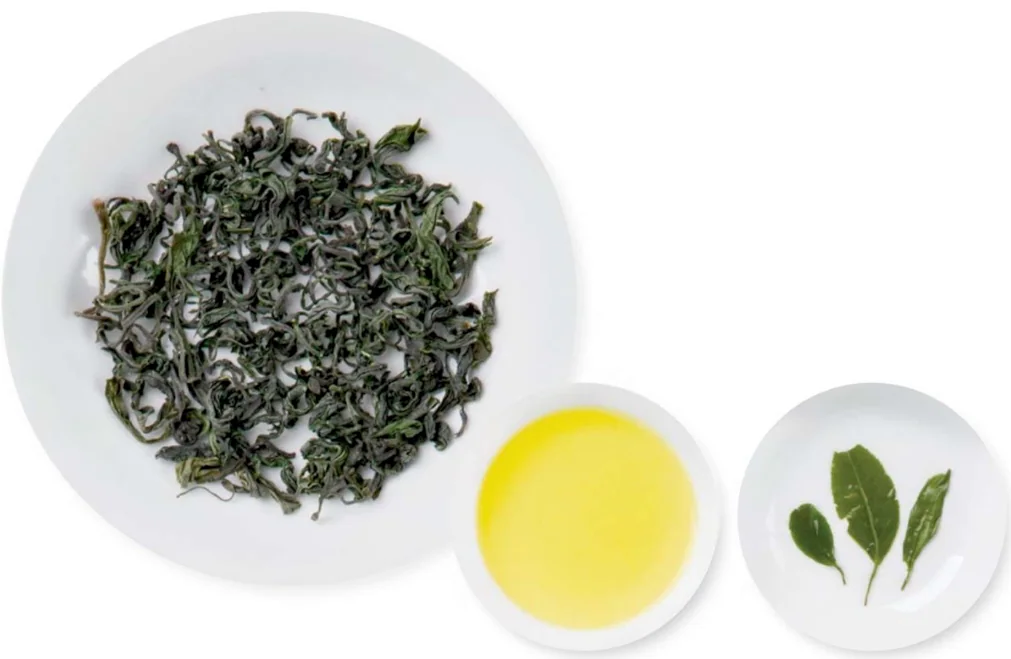
| Typical shape | Tightly curled or twisted leaves |
| Typical color | Deep green, sometimes almost black-green |
| Leaf character | Relatively thick and substantial |
| Typical aroma | Strong, fresh, chestnut-like |
| Liquor | Bright yellow-green |
| Taste | Fresh, mellow, brisk and sweet |
| Beginner temperature | About 80–85°C / 176–185°F |
The current Shandong geographical-indication standard DB37/T 2709-2015 remains in force and covers the protected Rizhao Green Tea product system. (全国标准信息公共服务平台)
Where Does Rizhao Green Tea Come From?
Rizhao Green Tea’s geographical-indication protection area includes the present administrative areas of:
Donggang District
Lanshan District
Ju County
and
Wulian County
within Rizhao. The original GI protection was approved in 2006, and authorized producers continue to receive approval to use the official geographical-indication mark. (110网)
So, as with our other tea pages:
“Rizhao Green Tea” is not merely a flavor description. It is also an origin claim.
A Green Tea That Had to Learn to Survive the North
The history of Rizhao tea is unusually recent.
From 1959 through the mid-1960s, tea seeds from Fujian and Zhejiang were repeatedly trialed in the Rizhao area.
Many plants died from:
cold,
drought,
and winter damage.
In 1966, new trial plots were planted in what were then Beishan and Shuangmiao villages.
The following year, some survived.
By 1967 and 1968, tea planting expanded quickly, and agricultural researchers concluded that parts of Rizhao could support larger-scale tea production. (日照新闻网)
This is why Rizhao Green Tea is not simply another old regional tea.
It represents a successful adaptation of tea agriculture into a colder northern environment.
What Was “South Tea Brought North”?
The Chinese phrase:
南茶北引
does not describe one tea variety.
It describes a wider agricultural effort to introduce tea cultivation farther north.
Shandong experiments began before Rizhao’s successful production.
Historical Shandong records document trials in several places during the 1950s and 1960s, with Rizhao eventually becoming one of the most successful examples. (山东地情档案)
So when you drink Rizhao Green Tea, you are tasting a tea industry that largely grew out of 20th-century agricultural experimentation, rather than a famous imperial-era tea tradition.
Why Can Tea Grow in Rizhao?
Rizhao lies near the Yellow Sea and has a climate quite different from many southern tea regions.
Its tea plants experience:
a longer winter,
cooler spring conditions,
large seasonal variation,
and significant risk from winter cold.
That colder environment slows the annual growth cycle compared with warmer regions.
But this should not be simplified into:
“Cold automatically makes better tea.”
Cold can also damage or kill tea plants.
In fact, early Rizhao tea experiments repeatedly struggled with frost and drought. (日照新闻网)
The useful lesson is:
Rizhao tea developed because growers learned how to work with a marginal northern tea-growing environment.
LOOK — What Does Rizhao Green Tea Look Like?
Rizhao Green Tea usually looks more substantial than an extremely delicate early-bud tea.
Common characteristics include:
tightly curled or twisted leaves
relatively thick leaf material
visible fine hairs on some grades
and
deep green to blackish-green color
The color is especially interesting.
Beginners often think:
greener = better green tea.
Rizhao Green Tea shows why that rule fails.
A good batch may appear quite dark.
Its leaves can be deep green with muted or almost black-green tones.
That does not stop it from being green tea.
Why Are the Leaves Relatively Thick?
Cooler growing conditions and cultivar choice can contribute to a sturdier leaf structure.
The geographical-indication system also permits several recognized cultivars, including historically introduced materials such as Longjing 43 and Fuding Dabai among others. (110网)
So Rizhao Green Tea is not one single botanical cultivar.
Again:
Regional tea name ≠ one tea-tree variety.
Different approved tea plants can be processed into Rizhao Green Tea.
SMELL — The Chestnut Aroma
One of the most recognizable traditional descriptions of Rizhao Green Tea is:
板栗香 — chestnut aroma
This is the same broad sensory vocabulary you have already encountered with several Chinese pan-fired green teas.
It does not mean chestnut flavoring is added.
Heat during green-tea manufacture can help generate:
nutty,
roasted,
bean-like,
and chestnut-like aromas.
Rizhao industry descriptions commonly emphasize a strong chestnut fragrance together with a rich, refreshing flavor. (大众网)
Does Every Rizhao Green Tea Smell Like Chestnuts?
No.
“Chestnut aroma” is an important regional descriptor, not a pass/fail laboratory test.
Depending on the batch, you may also notice:
fresh greens,
sweet vegetation,
flowers,
roasted grain,
beans,
or light nutty notes.
Harvest and firing style can change the aroma significantly.
BREW — How to Brew Rizhao Green Tea
Because the leaves are often relatively sturdy, Rizhao Green Tea usually tolerates slightly more heat than extremely delicate bud teas.
A good beginner starting point is:
| Parameter | Starting Point |
|---|---|
| Tea | 3–4 g |
| Water | 180–200 ml |
| Temperature | 80–85°C / 176–185°F |
| First infusion | About 30–60 seconds |
| Vessel | Clear glass or porcelain gaiwan |
If the tea feels thin:
increase temperature slightly.
If it becomes harsh:
reduce temperature or infusion time.
Glass or Gaiwan?
Both work well.
A clear glass allows you to watch the curled leaves expand.
A white porcelain gaiwan gives you better control over infusion time and makes the liquor color easy to evaluate.
For beginners learning tea, try both.
The tea will teach you how vessel choice changes extraction.
Does Rizhao Green Tea Need to Be Rinsed?
Normally no.
Good green tea does not need the first infusion discarded as a routine cleaning step.
If you want to moisten the leaves briefly before the main infusion, you can.
But that is a brewing choice—not a hygiene requirement.
TASTE — What Does Rizhao Green Tea Taste Like?
Compared with some extremely delicate Chinese green teas, Rizhao Green Tea can feel:
stronger
fuller
and
more substantial.
Common descriptions include:
fresh,
mellow,
sweet,
brisk,
nutty,
and chestnut-like.
Its relatively thick leaves can produce a cup with noticeable body.
This is part of what makes Rizhao interesting beside teas such as Biluochun.
Is Rizhao Green Tea Supposed to Be Bitter?
Some bitterness and astringency are normal tea sensations.
But strongly harsh tea may simply be overbrewed.
Before blaming the leaf, check:
water temperature
leaf quantity
steeping time
and
water chemistry.
Do not use bitterness as an authenticity test.
Is Rizhao Green Tea Really “Five-Infusion Tea”?
You may encounter claims that good Rizhao Green Tea can be infused five times without losing fragrance or becoming bitter.
It is true that Rizhao Green Tea is often praised for being relatively durable in brewing.
But:
Five infusions is not a rule.
A tea’s useful number of infusions depends on:
leaf quantity,
harvest,
grade,
brewing method,
temperature,
and your own definition of when a tea is “finished.”
A good tea may remain enjoyable over several brews.
That is the useful point.
What Color Should the Liquor Be?
Expect something around:
bright yellow-green
greenish yellow
or
light golden green.
Again, do not expect neon green.
Official and regional product descriptions commonly emphasize a bright yellow-green liquor rather than extremely vivid emerald color. (大众网)
READ THE LEAVES
After brewing, spread out several leaves.
Look for:
relatively thick leaf tissue,
healthy green or yellow-green color,
softness,
flexibility,
buds and leaves appropriate to the grade,
and reasonably consistent picking.
The original GI technical requirements distinguish grades by picking standard—for example, higher grades emphasize one bud and one young leaf, while later grades can include more developed leaf sets. (旭丰技术)
That gives us another useful lesson:
“Rizhao Green Tea” does not have one single leaf size.
Grade matters.
Spring Rizhao Green Tea
Spring tea is particularly valued because the growing season begins later than in many southern tea regions.
Cool spring conditions can mean slower early shoot development and limited early-season supply.
That can make early spring tea:
scarcer,
more expensive,
and more tender.
But do not turn:
later northern spring = automatically better
into another rule.
Weather and processing still matter.
Is Rizhao the Northernmost Tea in China?
Be careful with this claim.
You will sometimes see Rizhao described as:
China’s northernmost tea
or
the northernmost major green-tea base.
The second version is safer.
Tea cultivation exists elsewhere at comparable or higher latitudes, and production boundaries can change.
Historical reporting does support describing Rizhao as one of China’s most important and highest-latitude large-scale green-tea production areas. (人民日报)
For ChinaTea101, I would write:
Rizhao is one of China’s best-known high-latitude commercial green-tea regions.
Not:
No tea grows farther north anywhere in China.
Is Rizhao Green Tea the “No. 1 Tea of Northern China”?
You may encounter:
北方第一茶
often translated as:
“Northern China’s No. 1 Tea.”
This is a regional prestige slogan.
It can be included as cultural or marketing context.
But ChinaTea101 should not present it as an objective ranking.
A safer sentence is:
Rizhao Green Tea has often been promoted locally as one of northern China’s leading green teas.
That tells the reader the cultural reality without turning marketing into fact.
The “Magical 35° Latitude” Claim
This deserves its own section because tea marketing loves latitude.
Rizhao lies at roughly 35–36° north.
Shizuoka in Japan and Boseong in South Korea also lie at broadly similar latitudes and are important tea regions.
That is interesting.
But it does not prove that:
35° north is a magical tea latitude.
Latitude influences:
temperature,
day length,
seasonality,
and climate.
But tea quality also depends on:
ocean influence,
elevation,
rainfall,
soil,
cultivar,
wind,
farming,
and processing.
Even two gardens at exactly the same latitude can have completely different climates.
What About the Famous Wine-Latitude Comparison?
Some tea marketing materials connect Rizhao’s latitude with famous wine regions.
ChinaTea101 should avoid that argument.
The world’s major wine regions occur across a broad range of latitudes.
There is no single “35° rule” that guarantees excellent wine—or tea.
The useful takeaway is simply:
Rizhao’s relatively northern coastal location helps create a different tea-growing environment from China’s warmer southern tea regions.
That’s enough.
We do not need mythology to make Rizhao interesting.
Its real history is already interesting.
Rizhao vs Southern Chinese Green Tea
Rizhao can be a useful comparison with more southerly teas.
A general tendency might look like:
Rizhao Green Tea
relatively thick leaves
strong aroma
fuller body
chestnut character
later spring growth
Very tender southern spring green tea
smaller early shoots
more delicate body
softer aroma
earlier harvest
But this is a broad comparison.
China contains too many cultivars and processing traditions for “north vs south” to become a strict flavor rule.
Rizhao Green Tea vs Xinyang Maojian
These two are particularly interesting because both represent relatively northern major Chinese green-tea traditions.
Rizhao Green Tea
Often:
curled,
thicker,
dark green,
full-bodied,
chestnut-like.
Xinyang Maojian
Often:
fine,
straight,
needle-like,
hairy,
fresh and chestnut-like.
Both can share a chestnut aroma vocabulary.
But visually they are very different.
Rizhao Green Tea vs Longjing
Longjing:
flat,
pressed,
tender,
often associated with bean-like and chestnut notes.
Rizhao Green Tea:
often curled,
thicker,
darker,
and more robust.
Again:
Chestnut aroma does not identify one particular tea.
Several pan-fired Chinese green teas can develop nutty or chestnut-like profiles.
Shape, origin and processing all matter.
Rizhao Green Tea vs Biluochun
Biluochun is typically:
tiny,
fine,
spiral-curled,
hairy,
and delicate.
Rizhao Green Tea tends to be:
larger,
thicker,
more robust,
and darker.
This is another good side-by-side comparison for beginners.
How to Buy Rizhao Green Tea
If you are simply trying the style:
focus first on freshness and good processing.
For higher-priced tea claiming protected Rizhao origin, check:
producer,
harvest date,
grade,
place of production,
GI mark,
and traceability information where available.
The National Intellectual Property Administration continues to approve producers for use of the Rizhao Green Tea geographical-indication special mark, including producers in Donggang and Lanshan. (国家知识产权局)
So:
leaf appearance can tell you whether the tea looks plausible; certification and provenance provide stronger evidence of origin.
The Official Standard
The currently listed Shandong standard is:
DB37/T 2709-2015
Geographical Indication Product — Rizhao Green Tea
It covers:
the GI production area,
classification and grades,
product requirements,
testing,
labeling,
packaging,
transport,
and storage. It remains listed as current on China’s national standards information platform. (全国标准信息公共服务平台)
Why Rizhao Matters in the Chinese Tea Atlas
Rizhao teaches a lesson that none of the ancient famous teas can teach quite as well:
Tea tradition can be created.
Tea culture is not frozen in the Ming or Qing dynasty.
A region that repeatedly failed to grow tea in the 1950s and early 1960s became a significant commercial tea region within a few decades. (日照新闻网)
That makes Rizhao Green Tea part of the story of modern Chinese agriculture, not just ancient Chinese tea culture.
And I think foreigners will find this story surprisingly interesting.
The ChinaTea101 Method
When tasting Rizhao Green Tea:
LOOK
Are the leaves curled or twisted?
Do they look relatively thick and naturally dark green?
SMELL
Can you detect a clean nutty or chestnut-like aroma?
BREW
Start around 80–85°C.
Adjust instead of blindly following one fixed recipe.
TASTE
Look for body, freshness, sweetness, bitterness and astringency separately.
READ THE LEAVES
How thick are the leaves?
What was the picking standard?
Are they healthy and flexible?
CHECK PROVENANCE
Does the producer support the Rizhao origin claim?
ChinaTea101 Rule
Do not judge Rizhao Green Tea because it comes from farther north.
Do not assume:
north = better
or
south = better.
And do not assume:
35° latitude = magical tea.
Instead understand what the region actually changes:
growing season + climate + cultivar + farming + processing.
That gives you a much better explanation for what’s in the cup.
FAQ
What is Rizhao Green Tea?
Rizhao Green Tea is a Chinese green tea produced in Rizhao, Shandong, whose modern industry developed largely through the 20th-century “South Tea Brought North” agricultural program.
When did tea growing begin in Rizhao?
Trials took place from the late 1950s onward, with repeated early failures. A key successful trial occurred in 1966, followed by expansion during the late 1960s. (日照新闻网)
Is Rizhao Green Tea a traditional ancient tea?
Its roots are much more modern than teas such as Longjing or Biluochun. Its major development dates from the 20th century.
Where is authentic Rizhao Green Tea produced?
The geographical-indication protection area includes Donggang, Lanshan, Ju County and Wulian within Rizhao. (110网)
What does Rizhao Green Tea taste like?
It is commonly described as fresh, mellow and full, with a pronounced nutty or chestnut-like aroma.
Why are the leaves dark green?
Deep green or blackish-green coloring can be normal for the style. Bright emerald color is not a universal quality requirement.
Why are the leaves thicker?
Cultivar, cooler growing conditions and picking standards can all influence leaf thickness.
What temperature should I use?
About 80–85°C / 176–185°F is a good starting point.
Should I rinse Rizhao Green Tea?
Usually no.
Can Rizhao Green Tea really be brewed five times?
Some batches are quite durable, but exactly five good infusions is not an authenticity or quality rule.
Is Rizhao Green Tea the northernmost tea in China?
It is safer to describe Rizhao as one of China’s best-known high-latitude large-scale green-tea regions rather than claiming absolutely no tea grows farther north.
Is it really called “Northern China’s No. 1 Tea”?
That phrase is used as a regional prestige or marketing description, not as an objective national ranking.
Is latitude 35° especially good for tea?
Not by itself. Latitude influences climate, but soil, ocean influence, elevation, cultivar, rainfall and processing also matter.
Are Rizhao, Shizuoka and Boseong at similar latitudes?
They are broadly in a similar latitude band, which makes the comparison interesting, but latitude alone does not explain tea quality.
Is Rizhao Green Tea protected by geographical indication?
Yes. Rizhao Green Tea has GI protection, and the current local product standard is DB37/T 2709-2015. (全国标准信息公共服务平台)
Sources & review status
- rizhao-green-tea.md — Owner-supplied editorial draft. Longform owner-supplied draft; citation rendering fixed and content reviewed against site fact-check patterns during the V1 publication QA pass.
Imported from rizhao-green-tea.md. Updated 2026-09-19. Last reviewed 2026-09-25
How we check claims